Welcome to our Zero to Hero challenge – where we’re taking our website from scratch and aiming for 100,000 traffic through content alone!
In this case study, we’ll document our progress every week, sharing the strategies we implement, the obstacles we encounter, and how our traffic grows as we push toward our goal.
New updates will be added weekly, so bookmark this page to follow along, learn what works, and watch as we take our website from zero to hero in real time!
Day 261: The Challenge Ends Here – Did We Hit 100K Traffic?
It’s been 261 days of content publishing, iteration, and experimentation. From small wins to frustrating plateaus, we’ve documented it all – the good, the bad, and everything in between.
But today marks the final update of our Zero to Hero challenge.
Why are we ending it now? Did we manage to hit the 100K traffic milestone?
And what did we learn after 261 days of pushing the limits of content?
Keep reading as we break it all down in this final report:
Our overall traffic stats (and whether we hit our goal)
Why we’re wrapping up the challenge
Key lessons from the journey
What’s next for us (and you)
Overall Traffic Performance
To accurately assess the impact of content alone, we isolated the data to only blog pages. This means no homepage, no landing pages, just blog traffic performance measured from November 11, 2024 to July 29, 2025.
Blog Posts Published: 302
Total Duration: 261 days
Organic Clicks (Traffic): 33,600
Impressions: 17 million
Average CTR: 0.2%
Average Position: 16.7
We Didn’t Hit Our 100K Goal, But…
So, the big question: did we hit 100,000 organic traffic?
The short answer is no. But here’s what we did achieve:
1. Our traffic grew – and it’s still growing
We gained 33,600 organic clicks, which is 33.6% of our goal. Not the full 100K we aimed for, but still a massive leap from where we started, and a number worth celebrating. Along the way, we also racked up 16.8 million impressions.
And more importantly, traffic is still on the rise. In fact, we’ve seen a noticeable uptick recently, especially after the June Core Update wrapped up.
2. Our overall website traffic crossed 100K
While our blog alone didn’t reach 100K, our entire website did.
We believe the blog played a significant role in that. Just take a look at how overall traffic surged once we started publishing content consistently.
3. We ranked higher for several high-volume keywords
Thanks to this challenge, we now rank on the first page for several competitive keywords, and we’re seeing steady traffic from them.
Here are some of our top-performing keywords:
Why We’re Ending the Challenge Now
After observing trends over the past few months, one thing became clear: AI is changing everything.
With the rise of AI Overviews and now AI Mode taking over more of the SERP, getting clicks has become significantly harder, even when you rank well.
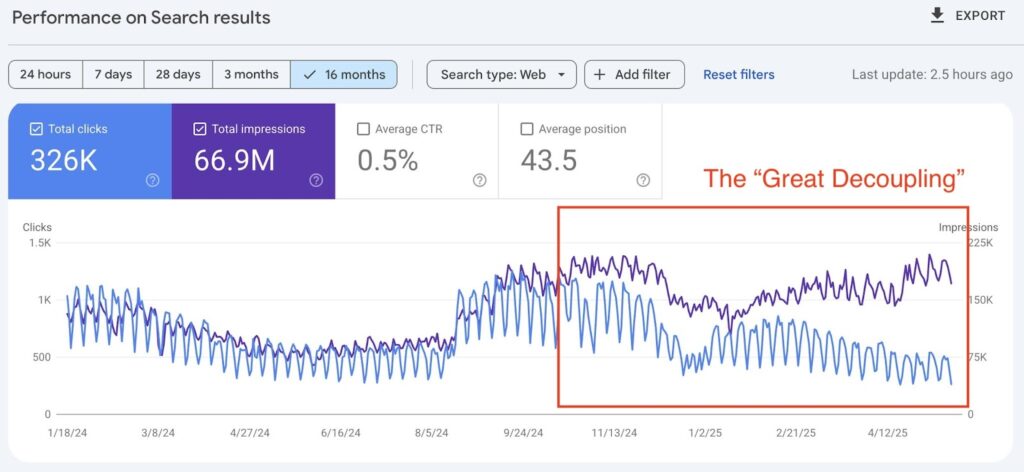
In fact, our own data backs this up. We’ve noticed a clear pattern in our traffic graph recently: impressions continue to climb, but clicks aren’t following – the phenomenon SEOs are calling “The Great Decoupling”.
People are seeing our content more often, but they’re not clicking through at the same rate.
Now, we could keep going. At the current pace, we’d eventually hit 100,000. But it will take a longer time than expected.
Plus, the rules of the game have changed, and continuing under the same challenge framework no longer makes strategic sense.
The search landscape is evolving fast, and we’d rather adapt and reframe than keep chasing a goal based on old rules.
Things We Learned Along the Way
Ultimately, this challenge was never just about chasing a number.
It was about learning what works, what doesn’t, and what it really takes to grow organic traffic with content alone.
So here are the key takeaways from our journey:
1. Scaling content works – when done right
Even though we didn’t hit 100K, we still hit 33K+, and that’s a whole lot better than zero.
Traffic moved in direct response to how much we published. When we started with 1 post per day, growth was slow. At 3–4 posts per day, it picked up. When we ramped up to 6 per day, we saw noticeably faster results.
That said, it’s not about blindly publishing in bulk. Pushing too much, too fast, can trigger Google’s scaled content abuse filters. What helped us was gradual scaling, combined with a focus on quality and indexing readiness.
2. AI content isn’t penalized if it’s high quality and unique
We used SurgeGraph to generate all our content – and the results speak for themselves. Pages ranked, traffic grew, and we weathered multiple Google updates without major impact.
But we didn’t just hit “generate” and publish. We made sure each piece:
Was SEO-optimized
Included original insights and unique information gain
Was guided by features like Knowledge, Topic Discovery, Flex, and Author Synthesis
In short, AI didn’t hurt us, but low-quality content would have.
3. A few “hero” pages drove most of our traffic
Out of 300+ blog posts, only a small subset generated the bulk of our traffic. We call these our hero pages – in-depth articles targeting high-volume, low-difficulty keywords.
Identifying the right topics upfront was critical. Tools like Topic Discovery helped us prioritize keywords with the highest potential to rank and drive traffic, and that focus paid off more than sheer volume ever could.
4. Technical SEO and internal linking are crucial
Early on, indexing was a bottleneck. Google was slow to crawl our posts, and manual submission through GSC wasn’t scalable.
So we got to work:
Optimized our sitemap
Added internal links to boost discovery
Optimized site speed and Core Web Vitals
Used a CDN to improve performance
Solved issues flagged on Google Search Console
Eventually, Google started indexing most of our posts within 24 hours of publishing.
5. The Great Decoupling is real
Toward the end, we noticed more obvious signs of the “Great Decoupling” (where impressions go up but clicks don’t follow) in our traffic graph, and we believe this is driven in large part by AI Overviews and zero-click searches.
But that’s the nature of SEO – the rules change, and they change very often. What worked yesterday might not work tomorrow.
What matters most is staying adaptable.
What’s Next?
The challenge may be over, but we’re far from done.
We’ll still be publishing content regularly – not just to grow our own traffic, but to continue improving SurgeGraph for users like you. Every post helps us refine the tool, test new strategies, and adapt to the continuously evolving search.
That said, this is the final update for this specific challenge, so there will be no more weekly reports.
But if you’ve been following along, we hope it’s been valuable, insightful, and maybe even a little motivating.
We still share SEO and AI content tips every week, so stick around if that’s something you can benefit from.
And who knows? A new, even bolder challenge might be on the horizon.
Thanks for coming on this journey with us. If you’ve got feedback, thoughts, or want to share your own story – we’d love to hear it.
Day 253: June Update Impact Far From Over
Google may have wrapped up its June Core Update last Thursday, but the SERPs are still anything but calm.
Since July 10, volatility has remained high, according to SERP trackers like Semrush Sensor and DataForSEO.
Despite the official end, we’re still seeing widespread fluctuations – proof that the update’s aftershocks are still rippling across the web.
Many sites continue to report instability in their rankings and traffic.
Considering all that, how did we do?
Traffic Performance
Here’s how our blog performed from November 11, 2024, through July 21, 2025:
Organic Clicks: 31,500
Impressions: 15,600,000
Average CTR: 0.2%
Average Position: 15.8
Total Blog Posts: 300
Compared to last week:
Clicks increased by 3.62%
Impressions rose by 4.00%
Average position slightly improved from 15.9 to 15.8
Despite the ongoing volatility, we’re holding steady, and even growing by a bit (you can see a slight uptick in our clicks on our traffic graph)! That’s a promising sign, especially when many others are still struggling to regain stability post-update.
Let’s see how next week unfolds.
Day 247: Early Effects of June Core Update Start to Kick In
We’re now 17 days into Google’s June 2025 Core Update – and the SERPs are shaking.
Over the past week, volatility has been off the charts, especially between July 10–16. If you’ve noticed some unusual movement in your rankings or traffic, you’re not alone. Many websites are reporting the same, and SERP trackers are also showing high volatility.
Some sites are reporting losses. Others are seeing long-awaited recoveries. It’s a mixed bag – but classic behavior for a core update still in progress. Google did mention this rollout might take up to three weeks, so we’re still in the thick of it.
Traffic Performance
Here’s how our blog is doing from November 11, 2024, through July 15, 2025:
Organic Clicks: 30,400
Impressions: 15,000,000
Average CTR: 0.2%
Average Position: 15.9
Total Blog Posts: 299
This week, traffic grew by 1,300 clicks (+4.5%), and impressions rose by 900,000 (+6.4%).
While growth hasn’t exactly surged, it’s steady. We’d love to see traffic ramp up more quickly, but given the climate of the SERPs right now, holding steady (and even inching forward) is something to be thankful for.
More to come next week as the dust (hopefully) settles.
Day 240: Fighting for Clicks in a No-Click World
We’re now 240 days into the challenge, and while we’re still moving up, we’re starting to feel the shift: earning traffic is getting increasingly harder.
But we’re not slowing down. We’re adapting, publishing, and pushing forward.
Read on to find out more.
Traffic Performance
Here’s how our blog performed from November 11, 2024, through July 8, 2025:
If their AI detector is accurate (and that’s a big if), then this points to something pretty clear: Google doesn’t seem to penalize AI-generated content, as long as it’s high quality and useful.
We’re seeing the same with our own SurgeGraph-generated content. We’re ranking well, and we’re getting traffic, so we know it works.
(PS: If you want to reliably check if your content looks AI-written and fix it, we just launched an AI Detector & Humanizer – try it out!)
…But AI Is Hurting Traffic
Even though AI isn’t harming rankings, it’s clearly impacting another metric: clicks.
We’re feeling it ourselves: our own impressions keep rising, but clicks aren’t keeping up, which is a clear sign of what many are calling “the Great Decoupling”. You can see it in our Search Console traffic graph: the blue (clicks) and purple (impressions) lines are starting to drift apart.
And we’re not the only ones noticing this.
One website we talked to shared that even though they’re ranking in the top 3 for multiple high-volume keywords… they still barely got clicks.
This tracks with a Similarweb study showing that zero-click searches jumped from 56% to 69% after the rollout of AI Overviews.
People are searching, but they’re not clicking, because they’re getting their answers directly from the SERP, either from a featured snippet, AI Overview, or AI Mode. With all these new “convenient features”, users no longer need to visit a website to get what they want.
Paid Search Isn’t Immune Either
It’s not just organic results taking a hit. Even paid ads are seeing a decline in click volume. CPCs are rising, but actual clicks are going down. As PPC Hero’s Mark Sansum puts it:
The rise of rich search results and answers (like Google’s generative AI results) can satisfy users’ queries without additional clicks… When ad supply (clicks) tightens and demand (advertiser spend) keeps growing, CPC prices are forced upward.
In short: there are fewer clicks to go around for everyone – both organic and paid search.
What’s Next?
It seems like our journey to 100K traffic is becoming increasingly challenging with the new developments going on.
But we’re not backing off.
Instead, we’re pushing forward – publishing more, optimizing better, and staying consistent. Clicks may be harder to earn, but consistency compounds, and over time, that still wins.
Day 233: Google Dropped a Core Update – Here’s How We’re Holding Up
We’re back with another update, and this one comes with some noise from Google.
This week, we published 18 new blog posts, pushing our total to 299 published articles.
But the bigger news? SERP volatility has been off the charts – and for good reason.
Volatile SERPs + Google’s June 2025 Core Update
On June 28, SEOs noticed something was up, with some noticeable ranking and traffic drops.
In line with these observations, tracker tools showed massive spikes in volatility on June 28 (9.3/10) and another on July 2 (9.1/10).
Shortly after, Google confirmed it had rolled out the June 2025 Core Update, the first confirmed update since March (despite the numerous shaky SERP episodes 👀).
According to Google, this update is designed to “better surface relevant, satisfying content for searchers from all types of sites.”
So… how are we holding up?
Traffic Performance
Here’s how our blog performed from November 11, 2024, through July 1, 2025:
Organic Traffic (Clicks): 28,000
Impressions: 13,300,000
Average CTR: 0.2%
Average Position: 15.6
Total Blog Posts: 299
Compared to last week, traffic is up by 4.48%, and impressions rose 6.40%.
Core updates typically take a few weeks to fully roll out, so as expected, we haven’t seen any major shake-ups in our numbers for now, which is a good sign.
We’ll continue to monitor closely as the core update rolls out further. But for now, looks like we’re all good (thankfully).
That’s it for this week’s update. See you in the next one!
Day 226: Early Signs of The Great Decoupling?
This week, we ramped up content production by publishing 16 new articles, bringing our total count to 281 blog posts published.
As for traffic? Let’s take a look.
Traffic Performance
Here’s how our blog performed from November 11, 2024, through June 24, 2025:
Organic Traffic (Clicks): 26,800
Impressions: 12,500,000
AverageCTR: 0.2%
AveragePosition: 15.3
Total Blog Posts: 281
Overall, we saw a 4.28% increase in clicks and a 5.04% increase in impressions from the week before. CTR and average position stayed the same.
Is the Great Decoupling Starting to Show?
Remember the Great Decoupling we mentioned two reports ago – where impressions and clicks no longer move in tandem, with impressions rising while clicks stay flat (or worse, drop)?
It’s starting to catch on more and more in the SEO community.
We’re seeing more SEOs and site owners discussing it, reporting that their own traffic graphs are beginning to show classic symptoms of the Great Decoupling.
Some even refer to it as the “open-mouthed crocodile” – a fitting visual of two lines (impressions vs. clicks) pulling further and further apart. Even someone from Google has acknowledged this pattern.
And it seems like our own traffic graph is starting to reflect this too.
Early on, clicks and impressions climbed together. But now, impressions are starting to pull ahead just a little more each week.
It’s a subtle divergence compared to some of the more dramatic graphs being shared, but it’s definitely there – especially with AI Overviews and AI Mode becoming more prominent.
People might still be seeing our listings (hence the higher impressions), but they’re less likely to click if the AI Overview or AI Mode already gives them what they need.
We’re keeping a close eye on this. Right now, it’s too early to confirm whether this is our Great Decoupling moment, or just a temporary thing.
But if the trend continues, we’ll need to adapt – not just by producing more content, but by making sure it’s un-copy-able by AI: unique, deeper, and harder to summarize.
Are you seeing similar trends in your traffic? Is the “crocodile” showing up in your GSC charts too?
Let us know – we’re curious how widespread this really is.
Day 219: One-Fourth of the Way There, But the Rules Just Changed
This week, we officially hit 25,000 organic clicks, which puts us at the 25% mark – or a quarter of the way to our 100K traffic goal.
But with AI Overviews and the newly launched AI Mode changing how search works, we’re entering a new phase – one where visibility doesn’t always mean traffic.
Read on to find out more.
Traffic Performance
Here’s how the blog performed from November 11, 2024, through June 17, 2025:
Organic Traffic (Clicks): 25,700
Impressions: 11,900,000
AverageCTR: 0.2%
AveragePosition: 15.3
Total Blog Posts: 263
Compared to last week, traffic increased by 4.90%, while impressions grew 7.21%. CTR and position remained steady. We also published new blog posts to prevent AI Overviews from stealing our clicks (read last week’s report for more details on what this is about).
How AI Overviews Affect Traffic
In the old days of search, higher rankings usually meant higher traffic. Unfortunately, that’s no longer the case.
We’ve been tracking this for a while now, and the correlation between rankings and traffic is clearly weakening.
Even when we rank in the top 10, traffic isn’t guaranteed, especially if Google decides to show an AI Overview.
Our data shows three distinct patterns emerging:
1. No AI Overview
If Google doesn’t show an AI Overview for a search query, we get the most traffic.
2.Featured in the AI Overview
If there is an AI Overview and we’re mentioned in it, we still get some traffic – though not as much as when there’s no AIO at all.
3. Not Featured in the AI Overview
If an AI Overview appears and we’re not included in it, we’ll get very little traffic.
Basically, whether or not we’re cited in the Overview now matters a lot. And whether or not an AI Overview shows up at all also makes a big difference.
Going off the “Great Decoupling” we mentioned last week, our recent findings continue to support that idea. AI Overviews are leading to more impressions, but fewer clicks.
Now AI Mode Comes In
On June 13, Google’s new AI Mode rolled out in the US. It looks and feels similar to the search mode in ChatGPT, where you can type in a question and get a full answer with links and citations to other webpages.
Here’s what AI Mode looks like:
Here’s a comparison with traditional search for the same search query (without AI Mode):
(What’s interesting to see here is that even though we rank high in both AI Mode and traditional search, the specific blog post that appears for the same query is different.)
Google also announced that clicks and impressions from AI Mode are now counted in Search Console, together with regular search and AI Overviews. However, there’s currently no way to isolate which traffic came from where.
What This Means for Content Strategy
So now, on top of AI Overviews impacting visibility, we have AI Mode adding another layer of complexity. It’s still too early to tell what kind of long-term impact this will have, especially since AI Mode is currently only live in the US.
But what’s clear is that the rules of search are changing – again.
That said, this doesn’t mean SEO is no longer worth it. It just means we need to rethink how we approach it. Ranking is still valuable, but the kind of content we create, and how we structure it – matter more than ever. Surface-level answers won’t cut it anymore.
To stand out, we need to dig deeper, offer unique perspectives, and create content that can’t easily be summarized by AI.
That’s something we’ve been working toward – specifically with new releases like Knowledge, and we have even more in the pipeline.
As search evolves, so will we. We’ll keep testing and building strategies that help you (and us) adapt – not just to stay in the game, but to come out stronger.
How’s your traffic holding up with AI Overviews and AI Mode in the mix? We’re curious to hear how it’s affecting others. Feel free to share your thoughts.
Day 212: Defending Our Traffic Against “The Great Decoupling”
Have you heard what SEOs are calling “The Great Decoupling” lately? Because that’s exactly what the new strategy we’re working on this week is about.
But first, let’s take a look at our traffic numbers.
Traffic Performance
Here’s how the blog performed from November 11, 2024, through June 10, 2025:
Organic Traffic (Clicks): 24,500
Impressions: 11,100,000
AverageCTR: 0.2%
AveragePosition: 15.3
Total Blog Posts: 256
This week, our traffic increased by 3.81% compared to last week. Meanwhile, impressions grew by 4.72%. The average CTR remained steady at 0.2%, and our average position is now 15.3.
Overall, while a faster growth would’ve been great, the current positive momentum is still a win when we consider the state of the SERPs these days.
Because SERP-wise, it was definitely a turbulent week.
According to Semrush Sensor and several other trackers, there was major ranking volatility between June 4th and June 8th.
As expected, many websites reported significant ranking fluctuations and traffic drops during this period.
Thankfully, we’re not seeing anything alarming on our end. So we’ll continue moving forward.
In fact, this week, we’re working on something new.
The “Great Decoupling”
There’s been a growing concern in the SEO world lately about AI Overviews stealing traffic away from websites. The problem stems from Google directly answering user queries inside the AI Overviews themselves. As a result, users often get the information they need without ever having to click through to a website.
For example, when I search for “what’s the best non dairy milk”, Google instantly gives me a summarized answer in the AIO, and even goes the extra mile to highlight the answer “soy milk”.
I get my answer within seconds, and honestly don’t feel the need to scroll down to check out the rest of the results, let alone click through any of the sources cited in the AIO.
And this is exactly what’s leading to the phenomenon SEOs are calling “The Great Decoupling”.
Traditionally, impressions and clicks would move fairly closely together: when impressions go up, clicks usually follow. But now, what we’re seeing more often is this:
Impressions rise, but clicks remain flat or even decline. They start to diverge and decouple.
What does this mean? While more people may see your site or your listing in the SERPs, fewer people are actually clicking through to visit your site. In other words, increased visibility doesn’t automatically translate to traffic anymore.
Of course, Google still cites its sources, which allows users to visit the original article. But realistically, if users get a quick, satisfactory answer to their query, there’s little incentive for them to click into the full article.
Unless (and this is key) the AI Overview can’t fully answer the query. If the answer requires more depth, more nuance, or additional information, users may still want to visit the original article to get the complete picture.
Strategy We’re Working on This Week
This is exactly what we’re starting to test: using article angles and approaches that AI Overviews cannot fully cover – forcing users to click through to read the complete answer.
Will this work? Can we prevent AI Overviews from siphoning off our traffic?
We’ll find out soon enough. Stay tuned to see how it plays out!
Day 205: 10 Million Impressions and Counting
As of Day 205, we’ve officially crossed the 10 million impressions mark! While this week didn’t bring major breakthroughs, it did show steady progress. Read on to find out how we did!
Traffic Performance
Here’s how the blog performed from November 11, 2024, through June 3, 2025:
Organic Traffic (Clicks): 23,600
Impressions: 10,600,00
AverageCTR: 0.2%
AveragePosition: 15.1
Total Blog Posts: 256
This week brings our total blog posts published at 256.
Organic traffic increased by +1,000 clicks (up from 22,600 to 23,600), a 4.42% growth compared to last week. Impressions grew by +720,000, from 9.88 million to 10.6 million. CTR stayed at 0.2%, while average position dipped slightly from 14.9 to 15.1.
We saw another round of SERP turbulence on May 29–30, according to Semrush Sensor.
There was a slight dip in our traffic on May 31, but nothing alarming – performance quickly stabilized by the start of the new week.
All in all, we’re still moving in the right direction. We’ll keep publishing consistently and let compounding growth do its thing.
One week closer to the 100K goal – see you in the next update!
Day 198: Closing in on 200 Days
It’s now Day 198 of our challenge to hit 100K organic traffic – we’re almost at the 200-day mark! How time flies. What started as an ambitious experiment has now become a long-haul journey filled with ups, downs, and progress.
Read on to find out how we did this week – and how close we are to our goal.
Traffic Performance
Here’s how our blog performed from November 11, 2024, through May 27, 2025:
Organic Traffic (Clicks): 22,600
Impressions: 9,880,000
AverageCTR: 0.2%
AveragePosition: 14.9
Total Blog Posts: 255
This week, we didn’t make any major changes and instead just stayed consistent with publishing, bringing us to a total of 255 blog posts.
Traffic-wise, we’re now at 22,600 total organic clicks, which is a +1,200, or 5.61% increase from last week.
Impressions are at 9.88 million, growing by around 800,000 or +7.51% – getting very close to that exciting 10 million milestone!
CTR held steady at 0.2%, while average position dipped slightly from 14.7 to 14.9.
Given the wild SERP volatility last week, this week’s performance is pretty good, and it’s worth noting that we’re starting to see a subtle upward trend again, especially compared to the slower weeks earlier.
Anyway, that’s it for this week. See you again in the next one!
Day 191: Still on Track, Even When the SERPs Aren’t
At Day 191, we’re standing at 21,400 organic clicks and over 9.1 million impressions with 254 blog posts published. While growth slightly slowed this week, it’s a good reminder that SEO isn’t linear, especially in times of turbulence.
Traffic Performance
Here’s the stats of our blog posts from November 11, 2024, through May 20, 2025:
Organic Traffic (Clicks): 21,400
Impressions: 9,190,000
AverageCTR: 0.2%
AveragePosition: 14.7
Total Blog Posts: 254
Week-Over-Week Changes
Compared to last week, traffic grew by 900 clicks, up from 20,500 to 21,400.
Impressions increased by 630,000, rising from 8.56 million to 9.19 million.
While the average position dipped slightly from 14.5 to 14.7, it’s nothing alarming, as position fluctuations are normal.
CTR held steady at 0.2%, indicating stable performance even as rankings and impressions fluctuated.
Another Week of SERP Volatility
SERP-wise, it has been anything but calm. Following last week’s instability, we saw continued volatility on May 16 (Friday) and again on May 20–21 (Tuesday-Wednesday), according to Semrush Sensor.
How did we do?
Well, these turbulences did cause a temporary dip in our traffic over the weekend. But by Monday and Tuesday, our traffic climbed back up.
Despite the multiple SERP volatility, there’s no confirmed Google update, no significant impact on our traffic, and hence no clear reason to shift our strategy.
As always, we’ll stay focused on publishing consistently – onward to 100K!
Day 184: 20K Down, 80K To Go!
We’ve officially crossed the 20,000 mark, which means we’ve hit 20% of our 100,000 traffic goal. It’s a big milestone and a strong reminder that persistence pays off, even when growth feels gradual.
Traffic Performance
Here’s how our blog performed from November 11, 2024, through May 13, 2025:
Organic Traffic (Clicks): 20,500
Impressions: 8,560,000
AverageCTR: 0.2%
AveragePosition: 14.5
Milestone Reached Despite a Double Dose of Volatility
We’ve crossed a key benchmark – 20,500 organic clicks – officially hitting 20% of our 100K traffic goal.
That’s over 8.5 million impressions accumulated since we kicked off the challenge, with an average position of 14.5 and a CTR holding steady at 0.2%.
While we’re celebrating this progress, there were some SERP turbulence reported this past week. Two separate volatility events happened: one between May 8–10 and another on May 13.
See the SERP Volatility tracker from Semrush below:
Lots of websites reported major drops in rankings and traffic as reported on seroundtable.com:
But thankfully, we pulled through just fine. There were minor dips around those dates, but nothing unusual or alarming, just the usual fluctuations of search.
As always, we’re watching the numbers closely – but for now, we stay the course. This kind of volatility is normal, and we’re still moving in the right direction.
Next Steps
We’ll continue refining our strategy to improve CTR and move up from that average position of 14.5. Expect more testing, more optimization, and more updates in the coming weeks.
Until next time – onward to 100K.
Day 177: Small Wins From The New Topic Cluster
A few weeks back, we launched a new topic cluster focused on the topic of “blog posts” (catch up on the full details here). Since then, we’ve been actively tracking its early performance – and the results are starting to take shape.
One blog post is pulling in the most traffic among the cluster
It’s also ranking well for multiple high search volume keywords.
The blog post is ranking well for multiple queriesIt’s currently ranking on position 9 above BacklinkoThe search volume of the keywords according to our new keyword research tool Topic Discovery
The pillar post itself hasn’t gained traction yet, which isn’t unusual at this stage. We’ll give it a few more days before deciding whether it needs a content refresh.
In the meantime, we’ve started tweaking and updating the other posts in the cluster to improve relevance and clarity.
Traffic Performance
Here’s how our blog performed from November 11, 2024, through May 6, 2025:
Organic Traffic (Clicks): 19,400
Impressions: 7,930,000
AverageCTR: 0.2%
AveragePosition: 14.3
Next Focus
Our next focus now is monitoring this cluster’s development as a unit. If the internal links and SERP-optimized structure work as intended, we expect to see a gradual rise in visibility and clicks across all related posts.
As always, we’ll continue publishing and refining as we push toward our 100K traffic goal. More updates soon!
Day 169: Weathering the Storm and Writing with “Knowledge”
This week was all about staying steady in shaky SERPs. With two waves of Google ranking volatility and chatter across the SEO community, we kept publishing, monitored performance, and came out the other side without major losses.
In fact, traffic and impressions were up. We also introduced a new tool that could help take our content strategy to the next level.
Google Search Ranking Volatility x2
This past week wasn’t business as usual in the SEO world – unless “business as usual” means weathering two Google ranking shake-ups.
Yes, two separate volatility spikes hit the SERPs hard on April 22–23 and again on April 25, as reported by industry trackers.
Many site owners reported sudden ranking drops and traffic losses during those days.
Want to try SurgeGraph for free?
Generate 20 documents
SEO tools (Auto Optimizer, Internal Linking, and more)
So, how did SurgeGraph’s blog fare amidst the SERP volatility?
Here’s the traffic stats of our blog posts from November 11, 2024, through April 28, 2025:
Organic Traffic (Clicks): 17,900
Impressions: 7,140,000
AverageCTR: 0.3%
AveragePosition: 14
Despite the turbulence, SurgeGraph’s blog fared well. In fact, we saw a traffic spike on April 23, followed by a slight dip on April 26.
However, the key takeaway is that we avoided any major drops.
In fact, our traffic actually increased by 7.19% compared to the previous week, and impressions rose by 9.85%.
We attribute this stability to strategies we’ve implemented over the past few months, including publishing consistently and focusing on high-quality content.
Next Steps: Smarter Content with Knowledge
As we continue to scale content, we’re now introducing a new capability into our workflow: Knowledge.
This new beta feature allows us to upload unique, non-public information into SurgeGraph – things like internal data, research, and documents. The AI can then pull from this knowledge base when generating content.
In a climate where helpful, original content is increasingly prioritized (and rewarded), we see this as a natural next step. It’s one more way to enrich our blog posts with original, valuable information.
You’ll start seeing this reflected in future posts as we test and iterate.
See you in next week’s update (hopefully with more growth and less volatility!).
Day 163: New Topic Cluster Launched
This week, we started building a new topic cluster optimized for key search terms and SERP features like AI Overviews, Featured Snippets, and PAA spots. While traffic growth wasn’t explosive, it was steady, and that’s what we like to see.
Let’s take a look at the numbers first.
Traffic Performance
Here’s how our blog posts performed from November 11, 2024, through April 22, 2025:
Organic Traffic (Clicks): 16,700
Impressions: 6,500,000
AverageCTR: 0.3%
AveragePosition: 13.9
Traffic Growth Continues With 1,300 More Clicks This Week
We saw an increase of 1,300 clicks from last week, bringing us to 16.7% of our 100,000 traffic goal, and an 8.4% week-over-week growth.
Average position slipped slightly from 13.8 to 13.9, but that’s expected as impressions climb. It suggests our content is surfacing for more search queries – even ones that are more competitive or new to our content footprint.
New Topic Cluster in Progress
We’ve been working on building a new Topic Cluster focused entirely on the topic “blog posts.”
We published over 20 articles covering keywords like:
how to repurpose old blog posts
best time to post a blog
how many blog posts to get traffic
blog post length for SEO
how to cite a blog post
…and many more.
The goal is to create a tightly linked cluster of articles and support them with a pillar page, which is currently in the works.
Once the internal linking is in place, we’ll start tracking how this cluster performs as a unit.
Optimizing for SERP Features
This batch of content is also part of our ongoing experiment to capture Featured Snippets, People Also Ask boxes, and potentially AI Overviews. To support that, we’re focusing on clear, structured answers and planning to add FAQ Schema markup to help Google better parse and present our content.
Next Steps
Moving forward, our next step is to finalize and publish the pillar page for this topic cluster. Once it’s live, we’ll focus on building internal links across the cluster to ensure all pieces are connected and support each other. We’ll closely monitor early signals such as impressions, the appearance of snippets, and PAA spots to gauge how well the content is performing.
To maintain consistent traffic growth, we’ll continue publishing regularly, making sure to refine and optimize as needed. With the new content cluster rolling out, we’re excited to see how it performs in the coming weeks. Stay tuned for updates on its progress!
Day 156: We Hit 15% of Our Traffic Goal!
This week, we continued publishing new blog posts consistently to keep the momentum going. While we didn’t run any new experiments, that doesn’t mean it was uneventful. Sometimes, consistency is the strategy – and this week, it paid off.
By continuing to publish content, we hit a milestone and officially crossed 15% of our 100,000 traffic goal. It’s a small milestone, but a meaningful one, especially since we’re achieving this with pure content alone. Let’s get into the traffic numbers.
Traffic Performance
Here’s the traffic performance of our blog posts from November 11, 2024, through April 15, 2025:
Organic Traffic (Clicks): 15,400
Impressions: 5,910,000
AverageCTR: 0.3%
AveragePosition: 13.8
Steady Growth and Reaching 15% of Our Goal
Compared to last week’s 14,200 clicks, we saw an increase of 1,200 clicks to 15,400 — that’s around an 8.5% week-over-week growth. Not bad for a week with minimal changes. This also brings us to 15.4% of our 100,000 traffic goal. Still quite a way to go, but a milestone worth celebrating!
One thing worth highlighting is that our average position remains steady at 13.8, even as impressions continue to rise. This indicates that our content is starting to appear for more search queries overall, especially in the mid-SERP range (positions 11–20). It suggests that Google is recognizing our content across a wider set of keywords. With continued optimization, these mid-SERP placements could become high-performing pages in the near future.
Last week, we secured a featured snippet and a People Also Ask (PAA) spot for “who owns youtube,” which likely contributed to this week’s traffic bump. We’re monitoring whether these spots hold against competitors, as they drive significant visibility. Our focus on clear, concise answers at the start of sections seems to be paying off, aligning with Google’s preference.
Next Steps
Although reaching 15% of our goal is exciting, there’s still a long way to go. We’ll keep publishing consistently, analyze what’s working, and refine along the way to maintain our growth trajectory and get us closer to 100K traffic.
Day 149: Can We Outrank Competitors With This Strategy?
This week, we’re seeing stronger traffic growth compared to recent weeks. We also managed to land a featured snippet and appeared in the People Also Ask (PAA) section for a high-traffic keyword with 20K search volume!
On top of that, we’re looking into a strategy that could help us outrank competitors who might seem untouchable but may not be as strong as they appear. If it works, this could become a core part of our strategy moving forward.
Let’s get into it.
Traffic Performance
Here’s how our blog has performed from November 11, 2024, through April 8, 2025:
Organic Traffic (Clicks): 14,200
Impressions: 5,380,000
AverageCTR: 0.3%
AveragePosition: 13.8
We Got a Featured Snippet & PAA Spot!
Recently, we secured a featured snippet and appeared in the People Also Ask (PAA) section for the search query “who owns youtube”.
We landed a featured snippet – yay!We also got a PAA spot – double yay!
Featured snippets are considered “prime real estate” on search results as they put us at the very top of Google Search – above even the #1 organic result. Landing one of these means instant visibility and credibility. Plus, appearing in the PAA section means Google sees our content as a strong answer to related questions.
This shows that our content is structured well enough for Google to highlight. In particular, we think that answering questions clearly and concisely at the start of a section helps with increasing chances of appearing in featured snippets and PAA.
We’ll also monitor whether this holds or if competitors manage to take it. If it sticks, that tells us we’re on the right track with our approach.
Possible New Strategy: Targeting High-Traffic but Weaker Pages
We’re exploring a new strategy to get an edge in search by targeting pages that are ranking high and getting traffic, but are actually weaker than us. The idea is that it’ll be easier for us to overtake these pages.
There are two things we can look at to identify these pages:
1. Domain Rank: Look for pages that rank well but have a lower domain rank than ours. These pages might be getting traffic, but their domain authority is weaker, making them more vulnerable to competition.
2. Effective Referring Domains (ERD): Look at pages with high traffic but low ERD. ERD refers to the number of unique, authoritative domains linking to a page. Pages with lower ERD than us are possibly weaker in reputation, which makes it easier for us to surpass them with better content.
This strategy is still in the planning stage, but it’s something we’re considering. If it works, it could even become a new feature within SurgeGraph.
What do you think about this approach? Let us know your thoughts, and stay tuned for next week’s update!
Day 141: Keeping the Momentum & Observing Trends
Over the past few weeks, we’ve tested different ways to grow traffic using only content. Some weeks bring big insights, while others, like this one, are more about keeping the momentum going and seeing how things play out.
Even without new experiments this week, publishing regularly is still a key part of our strategy. Here’s a look at how things are going.
Traffic Performance
Here’s the performance of our blog posts from November 11, 2024, through March 31, 2025:
Organic Traffic (Clicks): 12,900
Impressions: 4,740,000
AverageCTR: 0.3%
AveragePosition: 13.8
Traffic is continuing to grow, showing that consistent publishing makes a difference over time.
Traffic Trends & Observations
Recent Blog Posts Are Picking Up – Some of our latest posts are starting to get more views, which means they’re gaining traction in search results.
Older Posts Are Bringing in More Traffic – As expected, content that’s been live for a while is ranking better and pulling in more clicks.
More Impressions, Same CTR – While impressions continue to rise steadily, CTR remains unchanged. This suggests that our content is appearing for more queries, but there’s room to optimize titles and meta descriptions to improve click-through rates.
What’s Next?
We’ll continue publishing and following our existing strategies while keeping an eye on traffic patterns. As always, we’ll monitor what’s working and adjust as needed.
Stay tuned for more insights as we continue our journey to 100,000 traffic!
Day 135: Optimizing for AI Overviews to Boost Clicks
With AI Overviews in the picture, many worry about zero-click searches, where users get answers instantly without having to visit a link, potentially leading to declining traffic.
But instead of resisting change, we decided to test how we can leverage it. So, we experimented with optimizing content with the aim to get cited in AI Overviews.
The result? Keep reading to find out!
In this week’s report, we go over how search is evolving, how AI Overviews work, and what we did to make them work for us.
Read on to discover what we’ve learned – and how you can apply it, too.
Traffic Performance
First, a quick look at our traffic progress so far. Here’s how our blog posts performed from November 11, 2024, to March 25, 2025:
Organic Traffic (Clicks): 12,100
Impressions: 4,320,000
AverageCTR: 0.3%
AveragePosition: 13.8
Now, onto the meat of this week’s report.
Search Is Evolving
It’s not just the classic ‘ten blue links’ anymore. Now we’ve got Knowledge Panels, Featured Snippets, AI Overviews, and many more. And Google is even experimenting with a new ‘AI Mode’.
Zero-click searches (the concept that people won’t need to visit our website, as Google provides answers upfront) definitely got us thinking.
But here’s the thing: we managed to get our content into a Knowledge Panel, and guess what? We actually saw an increase in traffic. Yes, more people are clicking through! It turns out, that even when Google is showing information directly, it can still drive people to your site if you play it smart.
So, instead of freaking out about this ‘zero-click’ future, maybe we should flip the script. Instead of fearing change, let’s embrace it.
In an interview with Barry Schwartz at Search Engine Land, Hema Budaraju, Google’s Sr. Director of Product, Search (AI) Generative Experiences, told Schwartz “that the link cards within AI Overviews generate a higher click-through rate than traditional web search results.”
Two weeks ago, we decided to experiment with Google AI Overviews.
The Technology Behind AI Overviews
Google’s AI Overviews, which evolved from the Search Generative Experience (SGE), utilizes the methods outlined in patent US11769017B1, ‘Generative summaries for search results’.
While the underlying principles are outlined in this patent, Google’s current AI Overviews leverage the advanced capabilities of the Gemini family of large language models.
This patent details how Google uses AI to create summaries from various sources to answer search queries. Below is a summary of how it works:
1. Understanding Your Request:
When you ask a question (a “query”), the system uses a large language model (LLM) to create a summary.
To make the summary accurate and helpful, the system uses not just your question, but also other relevant information (“additional content”).
2. Finding Relevant Information:
This “additional content” comes from various search results:
Directly related results: Documents that directly answer your question.
Related questions: Documents that answer questions similar to yours (e.g., questions asked around the same time).
Your recent searches: Documents from your past searches.
Guesses about what you might want: Documents based on your profile or the context of your question.
3. Creating the Summary:
The LLM takes all this information (text, images, videos) and generates a clear, natural language summary.
It might use your original question as context, or it might not.
The LLM can summarize by:
Quoting directly from the information.
Rewording the information.
Adding its own knowledge, based on the information it processed.
What We Are Testing
For the past two weeks, we started to focus on articles structured for AI Overviews.
Traditional SEO factors still apply for Google AI Overviews. But to increase the likelihood of our content being cited, we prioritize structuring information in a way that AI can easily understand.
We found that answering the article’s main question concisely increased the likelihood of Google AI Overviews directly linking to the relevant text fragment (the specific section).
The precise cited text fragment is shown below:
What’s Next?
As search continuously evolves, we believe it’s important to adapt – not just to survive, but to seize new opportunities.
By structuring our content to play nicely with AI Overviews, we’ve already seen promising citations and traffic boosts in just two weeks.
But we’re not stopping there. Next, we’ll test if Schema Markup can boost our visibility in AI Overviews even more. Stay tuned for the results!
Day 128: Testing Freshness – Can Trending Topics Boost Traffic?
This week, we’ve hit 11,100 organic clicks, marking another step forward in our journey to 100,000 traffic. While growth remains steady, we’re shifting gears to test a new approach – leveraging fresh, timely news to see if it can accelerate our progress.
Traffic Performance
Here’s how our blog posts performed from November 11, 2024, to March 18, 2025:
Organic Traffic (Clicks): 11,100
Impressions: 3,840,000
Average CTR: 0.3%
Average Position: 12.6
Compared to last week, our traffic increased by 1,000 (from 10,100 to 11,100). Meanwhile, impressions increased by 420,000 (from 3.42M to 3.84M). Our average position took a slight dip from 12.2 to 12.6.
Experimenting with Fresh Content
As traffic continues to rise, we’re paying close attention to our average position, which has seen a slight dip. This could be the result of increased competition, aging content, or even the Google March Core Update, which often brings shifts in search rankings.
To address this, we’re experimenting with freshness by focusing on timely, high-interest topics. Instead of relying solely on evergreen content, we’re testing whether covering major industry news can generate a surge of search interest and drive more clicks.
Why this matters:
Trending topics tend to have less initial competition, which gives us a competitive edge in ranking.
Fresh news content can spark immediate traffic spikes from users searching for real-time updates.
Google’s algorithms often favor fresh, relevant content, helping to improve indexing speed and overall visibility.
What’s Next?
Over the coming weeks, we’ll closely monitor how our news-driven content performs in search compared to our evergreen articles. If timely content proves to be a viable strategy, we may start incorporating more trending topics to complement our long-term traffic growth. At the same time, we’ll look for other high-interest industry news that could drive similar results, ensuring that we’re consistently tapping into search demand as it happens.
While experimenting with fresh content, we won’t lose sight of our core strategy – publishing consistently and optimizing for long-term growth.
Day 121: We Reached 10% of Our Goal!
This week marks a significant milestone – we’ve officially crossed 10,000 organic clicks! That’s 10% of our ultimate goal of 100,000 traffic. It might not seem like much in the grand scheme, but to us, it’s a huge win.
Additionally, our primary focus this week was monitoring and executing the strategies we outlined last week. As it may take time to see results, we’re using this period to observe, analyze, and optimize.
Traffic Performance
Here’s the performance of our blog posts from November 11, 2024, to March 11, 2025:
Organic Traffic (Clicks): 10,100
Impressions: 3,420,000
Average CTR: 0.3%
Average Position: 12.2
Compared to last week:
Traffic grew from 9,240 to 10,100
Impressions surged by 400,000
Average position improved slightly from 12.4 to 12.2
The Road Ahead
Looking back, the start was tough. Slow. Frustrating.
Getting even 100 clicks felt like an impossible task. Every slight uptick in traffic required an immense amount of effort – writing, optimizing, and testing different strategies, all while hoping for the best. There were moments of doubt, times when progress felt invisible. But we kept pushing forward.
And then, finally, momentum kicked in. The numbers started climbing, little by little. That once-distant 10,000 mark now stands behind us, proving that our strategies are working.
Although we’ve still got a long way to go, this milestone proves one thing: traffic growth using content is possible. And if we can do it, so can you. Staying consistent and trusting the long-term process is one part of it…
…But most importantly, having the right tool (SurgeGraph 😉) to speed up progress and execute an effective content strategy is key. This challenge is proof.
So, we’ll keep pushing, testing, and learning until we hit 100,000 traffic. The only question is when – not if.
See you next week!
Day 115: Testing New Strategies to Hit 100K Traffic
This week, we’ve been busy experimenting with new strategies – mixing in bottom-of-funnel posts, exploring AI Overviews (AIO) for traffic potential, and laying the groundwork for Schema Markup down the line.
Traffic-wise, we’re making steady gains, with organic clicks up over 50% since the last update and impressions crossing the 3 million mark.
We’re not at 100K yet, but the needle’s moving in the right direction, and these new strategies could be the key to getting us there. Read on to find out more!
Traffic Performance
Here’s the performance of our blog posts from November 11, 2024, to March 5, 2025:
Organic Traffic (Clicks): 9,240
Impressions: 3,020,000
Average CTR: 0.3%
Average Position: 12.4
Since the last update, we’re seeing solid growth in traffic.
Organic clicks jumped from 6,100 to 9,240 – an increase of 3,140 clicks, or roughly 51.5% more traffic.
We also hit 3 million impressions! This is a significant 42.5% increase from 2,120,000 impressions on our last update. Clearly, our content is getting in front of more eyes and showing up in more searches, which is a great sign for our goal.
Now, about the average position – we hope you’re not sick of hearing us ramble about this – we’re genuinely pleasantly surprised that our rankings keep rising!
We thought we’d hit a plateau by now, but nope, we’re still climbing. While we were at 13.2 on the last update, now we’re at 12.4.
This consistent improvement shows our content’s sticking power in search results. Our focus on quality and relevance seems to be paying off, and we’re excited to see how far we can push this!
What We Did
1. AI Overviews (AIO)
We’ve been thinking about how to reliably create AI content that pulls in predictable traffic – like a formula where X pieces of content equal X amount of traffic.
One angle we’re excited to test is optimizing for AI Overviews, which seem to drive more traffic than Featured Snippets (per this Sistrix study).
Recently, our “Who Owns YouTube” page saw a surge in traffic when it briefly appeared in a knowledge panel. Though it’s not quite an AI Overview, but it was close enough to spark an idea to look closer into AI Overviews.
After digging deeper, we found out our “Who Currently Owns Alphabet” page is used in an AI Overview, and as a result brought us 590 clicks in three months.
Based on analysis, it seems that AlO is a “play on entities” with the traditional ranking factors being less important.
This is a chance for us to punch above our weight, and create a formula for Al content creation.
2. Schema Markup
Based on data from our testing with listicles, we’re convinced Schema Markup could give them a boost in visibility.
Schema might also improve our chances of landing in AI Overviews by adding clarity about our content to Google.
For now, though, we’re prioritizing new AIO-focused content – Schema will come later once we’ve tested the waters.
3. Bottom-of-Funnel Content
Up until now, our blog posts have mostly targeted top-of-funnel keywords to build broad awareness. This week, we started weaving in some bottom-of-funnel topics to capture warmer leads – users closer to a purchase decision – while still keeping up with our top-of-funnel efforts.
Since we’ve just published these, it’s too early to see results, so we’ll need time to see how they perform – more on that in a future update.
Our Next Steps
That’s a wrap for Day 115!
In the coming weeks, we’ll be fine-tuning our approach – watching how those bottom-of-funnel posts settle in, digging deeper into AI Overviews to see if we can crack that traffic code, and maybe even dropping a few more content experiments into the mix.
We’re excited to see where these steps take us. Stick with us for the next update!
Day 100: We Didn’t Hit 100K, But We’re Not Stopping
Can you believe it’s already been 100 days since we set out on this extremely ambitious challenge?
From day one, this challenge has been a roller coaster ride. Some of you cheered us on and rooted for our success. Others were skeptical and said it would be impossible. And then there were those who quietly observed from the sidelines, waiting to see if we could pull it off.
Now, we stand at the finish line of this challenge.
It’s day 100 – the final checkpoint. And the big question remains: Did we hit our goal?
Did we successfully reach 100,000 organic traffic relying purely on content generated by our own AI writing tool?
Keep reading, because we’re about to break it all down for you.
Traffic Performance Summary
Over the course of 100 days, we published a total of 202 blog posts – all generated using our AI writing tool, Vertex.
Here’s how our blog posts performed:
Organic Traffic: 6,100
Impressions: 2,120,000
Average Click-Through Rate (CTR): 0.3%
Average Position: 13.2
Note: The traffic data only includes visits to our blog posts and excludes other pages like our homepage. This ensures we’re measuring the direct impact of content alone, without external factors influencing the results.
We Didn’t Hit 100K Traffic
So, did we manage to get 100,000 traffic in 100 days? No.
But we did gain 6,100 organic traffic.
And given the competitive niche we’re in, the continuous Google updates, and the cold start of this challenge, we believe it is still meaningful progress.
Just look at the trajectory. On day 21, we only managed to get 17 traffic.
But by day 100, that number skyrocketed to 6,100 traffic – a 35,782% increase.
This growth proves that traffic is a long game, and while 100 days may not be enough to reach 100K traffic, it is enough time to prove that consistent content publishing leads to steady, compounding results.
Building off of this, we’re not stopping here. We’re going to keep pushing on.
Goodbye, 100K in 100D – Hello, Zero to Hero
So, our journey to hit 100,000 traffic isn’t over – far from it.
We’re not giving up just because we didn’t hit the mark in 100 days. We realize that if we could reach 6,100 traffic, then 100,000 is absolutely possible.
The real question now is: How fast can we get there? How long will it take?
That’s exactly what we’re setting out to discover in our next challenge: Zero to Hero.
Why the name “Zero to Hero”?
Unlike big websites with high DAs and tons of backlinks, we’re building from the ground up. And that’s the whole point – we want to show that even smaller websites, like yours and ours (“zero”), can grow 100,000 traffic and succeed (“hero”).
And while many gurus and experts out there talk about SEO, how many have actually delivered and shown the process of hitting 100,000 traffic – live, in real time?
That’s why this challenge matters. And that’s why we’re continuing.
We’re going to keep publishing at scale, refining our strategies, and sharing every step of the journey with you – so you can see firsthand what it really takes to reach 100K traffic.
PS: A huge thank you to everyone who followed along, shared feedback, and supported this challenge. We hope you learned something valuable from our insights and experiences. See you in the next challenge!
Day 97: Highest Single-Day Traffic Spike Yet
This week, we hit another milestone in our challenge, recording our highest traffic surge on a single day. And with just days to go until the 100-day mark, our blog’s performance continues to build steadily, showing that our efforts so far are paying off.
What We Did
This week, we continued testing and refining our process for identifying hero pages to make it scalable and more efficient.
More importantly, once we’ve gathered enough data to confirm its consistency in delivering strong results, we’ll share the exact steps so you can replicate this strategy and, hopefully, achieve similar success.
We also started testing content generation with Gemini and will be comparing its performance against OpenAI. We’ll share our findings in the upcoming updates as we evaluate which tool delivers better results.
Traffic Performance
Here’s the performance of our blog posts from November 11, 2024, to February 15, 2025:
Organic Traffic (Clicks): 5,560
Impressions: 1,920,000
Average CTR: 0.3%
Average Position: 13.5
Wins of the Week
Our biggest win this week was hitting our highest single-day traffic peak on February 11.
On that day alone, our blog posts received 570 clicks and 248,657 impressions, making previous peaks look small in comparison.
This surge confirms that our current strategies are driving strong momentum, so we will continue building on these efforts.
We also saw a 53.59% increase in organic traffic, jumping from 3,620 clicks last week to 5,560 this week. Impressions also saw a significant boost, rising 71.43% from 1.12 million to 1.92 million.
And once again, our average position continues to improve, moving up from 17.8 last week to 13.5 this week. This means we’re steadily climbing the ranks and solidifying our presence on search results.
In Our Next Update…
The 100-day mark is just around the corner, so we’ll be sharing an update real soon. Be sure to keep an eye out – this will be an important report you won’t want to miss!
Day 90: #1 Ranking & 1 Million Impressions
This week, just like before, we focused on publishing high-impact hero pages and closely observed their performance.
And the numbers show that we’re on the right track – 1.12 million impressions, a #1 ranking, and 230 keywords on Page 1!
Here’s what went down this week and what’s coming next.
Traffic Performance
Here’s how our blog posts performed from November 11, 2024, to February 8, 2025:
Organic Traffic (Clicks): 3,620
Impressions: 1,120,000
Average CTR: 0.3%
Average Position: 17.8
Key Highlights
1. We Hit 1 Million Impressions!
This week, we hit a major milestone: we crossed over 1.12 million impressions, a 33.65% increase from last week. This is a huge win and shows that our content is gaining visibility in the SERPs.
Our organic traffic also continues to grow, hitting 3,620 clicks this week – a 34.57% increase from last week.
Additionally, although we thought our average position will eventually plateau after consistently going up for a few weeks, but it exceeded our expectations once again.
Our average position is now 17.8, up from 19.7 from last week.
2. Number 1 Ranking for a Query
While analyzing the queries that are driving the most traffic to our website, we discovered something exciting:
We’re now ranking #1 for a query – right above Wikipedia (which has a DA of 93)!
This is a massive win and further proof that our hero pages are dominating the SERPs.
3. Number of Keywords Ranking on the First Page Increased
We’re now ranking for a total of 230 keywords on the first page – a massive jump compared to the start of the challenge, where we barely ranked for 20 keywords.
Our Next Steps
Moving on, we’ll shift our focus to a full-funnel content strategy, targeting each stage of the customer journey (top, middle, and bottom). This approach will allow us to not just drive traffic but also generate leads. Also, for this purpose, we’ll introduce an additional metric for tracking conversions.
However, we’ll need more time to fully flesh out this strategy. Here’s how we plan to do it, primarily by seeding content from the articles we publish:
1. Continue Publishing Content. We’ll continue publishing content generated by our AI writer for efficiency, as it allows us to rank articles in as little as a few days.
2. Collect Data from Published Articles. Data from these articles will inform our next steps, helping us understand what’s working and what’s not.
3. Refine Strategy to Create High-Impact Hero Pages. Based on the insights gathered, we’ll refine our strategy to create hero pages that deliver maximum impact.
An example of this process in action is an article we recently published about DeepSeek, the latest AI tool that’s creating huge waves and quickly catching up to ChatGPT in popularity. Within days of publishing, the article is already ranking on Page 1.
The fact that Google is willing to rank this article (seeing it as related to our website niche) is a strong signal that we’re on the right track.
While the DeepSeek article currently drives little to no traffic (for now), it gives us valuable insights into what to write next. This is far more effective than relying solely on SEO tools and keyword research, as it provides real-world data on what’s working.
Stay tuned to learn more about how we execute this strategy and the results it delivers!
Day 83: New Traffic Peak
For the first part of the challenge, we focused on content velocity, starting with one to two posts per day and then ramping up to five posts per day. While this approach helped establish topical authority and build momentum, we quickly realized that hero pages had the potential to drive significantly greater results.
So instead of prioritizing sheer volume, we made a strategic pivot, shifting our focus toward publishing fewer but more impactful hero pages. This meant investing more time in keyword research, optimizing content, and ensuring each page was designed to rank well.
Over the past week, we published four new hero pages, and as expected, they are already performing well.
Traffic Performance
Here’s how our blog posts performed from November 11, 2024 – February 1, 2025 (data from Google Search Console).
Organic Traffic (Clicks): 2,690
Impressions: 838,000
Average CTR: 0.3%
Average Position: 19.7
While we’re seeing good traffic growth, the most notable improvement this week is in our average position, which jumped from 22.1 to 19.7.
This is largely due to the new hero pages, which quickly ranked in the top 10 for multiple queries and pulled up our overall site average.
Wins of the Week
1. Ranking #4 for a Keyword, Right After Wikipedia
One of our new hero pages, published on January 29, is already ranking on the first page of Google at number 4.
A blog post published 5 days ago is already ranking at position 4 on Google
Remarkably, this page sits just below Wikipedia and a high-authority domain, despite having no backlinks. Its rapid ascent to the first page shows the effectiveness of our keyword selection, content quality, and search intent optimization.
This page has already started driving traffic, proving that the hero page strategy is not only viable but also scalable.
Speaking of hero pages, they continue to be the best-performing content on our site. A quick look at Google Search Console insights confirms that our top queries are all driven by the hero pages, consistently bringing in the highest traffic.
Google Search Console insights showing our top 5 queries driving traffic
2. Secured Another Featured Snippet (Position Zero)
Our first-ever hero page, which has already been a strong traffic driver, has now earned a second featured snippet, also known as position zero.
We gained another featured snippet
This is a strong indicator that Google recognizes our content as authoritative and highly relevant to searchers. Featured snippets significantly improve click-through rates and brand visibility, as they place our content directly at the top of the search results.
3. New Traffic Peak on January 28
Finally, we reached a new traffic peak on January 28, surpassing our previous record. On that day, our average position was 9.4, meaning a significant number of our pages were ranking within the top 10.
We hit a new traffic peak on January 28, 2025Stats of our new peak
Key Takeaways
This week’s results further reinforce the effectiveness of our hero page strategy. The data clearly shows that publishing high-quality, well-optimized pages is far more impactful than simply increasing content volume.
This aligns with our recent decision to revamp our AI writing tool. With the rise of AI-generated content, the web has been flooded with low-quality, mass-produced articles. While this approach worked in the short term, Google responded with multiple algorithm updates that completely wiped out websites relying on low-effort AI content. Many sites that had been publishing bulk AI-generated content disappeared from search results, losing all their traffic and rankings overnight.
Recognizing this shift, we completely revamped SurgeGraph into SurgeGraph Vertex, an AI writing tool designed for quality, not just quantity. We now use the best AI model, with built-in humanization, information gain, brand voice adaptation, and more, to generate high-quality, unique content that can truly rank.
Our success with hero pages is proof that this strategy works. High-quality, humanized content that delivers real value is the future of SEO. Just as our hero pages outperform bulk content, SurgeGraph Vertex empowers users to create ranking content that stands the test of time.
Next Steps
With less than three weeks left in the challenge, we will continue doubling down on hero pages to maximize our traffic growth. Given the strong performance of our most recent pages, our primary focus will be to scale this approach and measure how far we can push our rankings before the challenge concludes.
Day 76: Doubling Down on Hero Pages
This week marks another exciting milestone in our journey toward hitting 100k traffic in 100 days!
Building on last week’s success, we published several more hero pages to further leverage the strategy that’s already driving strong results.
And once again, we’re seeing promising traffic increase this week, proving that this approach continues to pay off.
Traffic Performance
Here’s a snapshot of our blog’s performance from November 11, 2024, to January 25, 2025:
Organic Traffic (Clicks): 1,670
Impressions: 619,000
Average CTR: 0.3%
Average Position: 22.1
Addressing the elephant in the room… yes, you’ll notice that our traffic peaked on January 20 before declining. However, even with the drop, the overall performance over the past two weeks has shown remarkable growth compared to the first 8 weeks of this campaign (as can be seen in the same graph).
What’s more exciting is that traffic from our blog posts has officially hit four digits, up from three digits just last week! This shows that our strategies are gaining traction and delivering results.
Here’s the breakdown of our improvements compared to last week:
Traffic increased by 267%
Impressions went up by 114%
CTR increased from 0.2% → 0.3%
Average Position jumped from 35.7 → 22.1
Addressing Last Week’s Skeptics
Last week, we introduced the “hero pages” strategy, which focused on high-opportunity keywords and resulted in a significant 364% traffic increase. While the results have been impressive, we recognize that some SEOs might question the relevance of the keywords we’ve ranked for – such as “who owns Google” – given they aren’t directly aligned with our niche as an AI writing tool and are better suited for top-of-funnel traffic.
We want to take a moment to clarify why this strategy still helps in the broader sense.
Firstly, ranking high for these terms and driving significant traffic sends good signals to Google about the authority and credibility of our website. And as we build our site’s authority, it makes it easier for us to rank for other, more relevant keywords down the line.
Want to try SurgeGraph for free?
Generate 20 documents
SEO tools (Auto Optimizer, Internal Linking, and more)
With the success we’ve seen from this strategy, we’re confident that it will pave the way for us to rank for more niche-specific keywords related to AI writing tools.
Additionally, this influx of traffic opens up opportunities for brand discovery. Even if visitors initially land on our site through unrelated queries, they may eventually discover our AI writing tool, explore our content, or convert when their needs align with what we offer.
Essentially, by focusing on driving traffic with high-opportunity keywords, we’re laying the groundwork for long-term SEO success and positioning SurgeGraph to rank higher for more targeted, relevant terms as our authority continues to grow.
This Week, We Continued Publishing More Hero Pages
Building on the momentum of last week’s success, we doubled down on the hero pages strategy by publishing several more in-depth articles targeting high-volume, winnable keywords based on our refined criteria. These pages have proven their value by driving significant traffic and further boosting our overall site performance.
As shown in the screenshot below, the newly published hero pages have quickly become some of the top-performing posts on our website. In just a short period, they’re already ranking in the top 10 and contributing valuable traffic. The early results confirm that this strategy is continuing to pay off and drive tangible growth.
What’s Next?
Next week, we’ll continue refining the hero pages strategy and closely monitor keyword rankings and traffic growth. Stay tuned to see how this approach evolves, how it will contribute to our ultimate goal, and whether we’re on track to hit 100k traffic by Day 100!
Day 69: Hero Pages to the Rescue: 364% Traffic Surge!
As you’ll see very soon, this is the best and most interesting week we’ve had so far.
We tried two new strategies, and we’re happy to share that the early results are incredibly promising!
In the span of only a few days, a single blog post is already driving significant traffic, ranking on page 1, and even outranking bigger websites with much higher Domain Ratings (DR).
And the best part? The strategies are relatively easy to implement, so we’re confident you can try them out too.
So, what exactly did we do to achieve this? (Hint: we’re calling one of them “Hero Pages”).
Keep reading to get the details and learn how to replicate this strategy on your own website!
Traffic Performance
Here’s a snapshot of our blog’s performance from November 11, 2024 to January 18, 2025.
Organic Traffic (Clicks): 455
Impressions: 289,000
Average CTR: 0.2%
Average Position: 35.7
In such a short period, our latest strategies are already paying off, with traffic showing a whopping 364.29% increase and impressions climbing by 228.04%.
The average position massively improved to 35.7, up from 49.9 previously, again driven largely by the success of our latest strategy.
Given it’s only been a few days since we implemented the new strategy, we’re confident that we’ll be seeing even bigger growth in the coming weeks.
What We Did
1. Focused on High-Impact “Hero Pages”
We analyzed numerous high-traffic blogs and discovered a consistent pattern: a small number of pages drive the majority of their traffic. This reflects the Pareto principle (often called the 80/20 rule).
Based on this insight, we’re prioritizing a select group of “hero pages.” These pages target high-volume keywords where we have a strong opportunity to rank well using our “winnability criteria.” We’ve developed our internal criteria for assessing “winnability,” which goes beyond simply looking at low competition.
This strategy differs from the traditional pillar-and-cluster model. While pillar pages broadly address a topic and cluster pages delve into subtopics, our hero pages are laser-focused on winnable, high-volume keywords. We then create supporting pages that complement these hero pages.
In the short time since implementing this strategy (just one week), we’ve already seen a rise in traffic to one of our hero pages.
We even appeared in the AI Overview, for “who owns 51% of google.”
Appeared in an AI Overview
And we secured a featured snippet for the same query.
Secured a featured snippet
While the rankings have yet to stabilize, you see us ranking just below Wikipedia for “who owns google” – a keyword with a volume of 33,000 and a keyword difficulty of 50.
Ranking right below WikipediaThe keyword has a volume of 33,000 and a keyword difficulty of 50
2. Crafted Emotion-Driven Titles
Another initiative we implemented last week was the use of more emotional words in our blog titles. These words have the power to resonate with readers on a deeper level, tapping into their desires, fears, or aspirations.
Consider this example: “The REAL Power: Who Owns 51% of Google?”.
The use of “REAL” piques curiosity by hinting at a hidden truth or an underlying power dynamic that’s not immediately obvious. This evokes a sense of intrigue and potentially even a slight suspicion, prompting readers to delve deeper and uncover the information.
While many websites use the plain vanilla title ‘Who Owns Google,’ we took a different approach. Our unique title may have influenced Google to diversify its Top 10 results, demonstrating the importance of fresh perspectives.
As a result of this strategy, we’ve achieved remarkable success. We’ve successfully outranked even higher-authority domains like Fool.com (DR 592) with our own domain (DR 390). We use Domain Rank (DR) from DataForSEO to measure domain authority.
Their (fool.com) title is ‘Who Owns Google? History, Shareholders, & Facts.’
Note: In case you were wondering, we did not build any backlinks to this article.
What We Learned
This week’s experiments taught us two key lessons:
Focus on “hero pages”: We’re prioritizing a select group of in-depth articles called “hero pages.” These pages strategically target high-volume keywords where we have a strong opportunity to rank well using our “winnability criteria”. Early results show this strategy is driving traffic.
Emotion-driven titles work: Adding emotional words to our titles helped us outrank much larger websites, proving that emotional engagement and fresh perspectives are key to attracting readers (and rankings).
In the Next Update…
Given the early success of our “hero pages”, we’ll be doubling down on this strategy!
Hence, over the coming weeks, we’ll be publishing more of these in-depth articles. We’ll continue to refine our “winnability criteria” to identify high-value keywords.
Find out what happens in our next update!
Day 49: Keyword Clustering Method
One of our core strategies going into this challenge is keyword clustering. This process involves grouping related keywords based on search intent, enabling us to create highly targeted content that resonates with what users are searching for. By using keyword clustering, we aim to improve rankings, increase engagement, and ultimately drive more traffic.
In this week’s report, alongside sharing our traffic performance, we’ll dive into the specifics of our keyword clustering methodology. So, read on to learn how we did it so you can replicate it for your website!
Our Keyword Clustering Methodology
We use SERP keyword clustering to group keywords by analyzing their search engine results. Keywords that produce similar search results are considered related and grouped into a cluster. This method aligns with user intent better because it considers how search engines interpret and respond to queries.
Refining Our Keyword Targeting Strategy
Instead of extracting competitor keywords where they rank in the top 30 SERPs, as we did previously, we narrowed our focus to those ranking in the top 10.
We also expanded our competitive analysis by adding another key competitor to the mix. This refined strategy allows us to hone in on the most relevant and impactful keywords for our content strategy.
A total of 12,979 keywords were extracted from 5 competitors.
Determining Cluster Thresholds
Keywords are clustered together if their top 10 search results share at least 3 common URLs. This strategy allows us to create highly targeted content that addresses specific user needs. While this approach may require creating more content, each piece will be laser-focused on user intent.
A lower threshold (e.g., 3) results in a higher number of clusters: A lower threshold means fewer common URLs are needed for keywords to be clustered together. This leads to more keywords meeting the criteria and being grouped into a cluster.
A higher number of clusters requires creating more content: However, each cluster allows content to be tailored to a specific topic. This results in highly targeted content.
A higher threshold (e.g., 5+) results in a lower number of clusters: A higher threshold means more common URLs are needed for keywords to be clustered together. This leads to fewer keywords meeting the criteria for a cluster.
Fewer clusters will result in the creation of less content: With fewer clusters, there will be fewer distinct content pieces to create. Consequently, each piece of content would need to address a wider range of user intents.
A total of 895 clusters were created by using a threshold of 3.
Why SERP Keyword Clustering?
SERP keyword clustering offers a more accurate understanding of search intent than semantic clustering (grouping keywords by meaning). By analyzing actual search results, we gain insights into how Google interprets and connects keywords.
Prioritizing Keyword Clusters Using Opportunity Scores
Using Opportunity Scores is part of our methodology to prioritize keyword clusters (fun fact: we scored a featured snippet for the keyword “Opportunity Score”. More details below.)
After compiling potential keyword clusters, we prioritize them using SurgeGraph Vertex’s Opportunity Score (OS).
The Opportunity Score tells you how easy it is to rank for a keyword and how much potential traffic that keyword has.
Essentially, the higher the Opportunity Score, the better the keyword’s potential.
Traffic Performance
Here’s a snapshot of our blog’s performance from November 11 to December 29, 2024:
Organic Traffic (Clicks): 98
Impressions: 88,100
Average CTR: 0.1%
Average Position: 49.9
Indexed Posts: 106/108 (98.15%)
Overall, impressions increased by 67.17%, while clicks rose by 40%, which shows steady growth.
Furthermore, newly published blog posts were all successfully indexed, bringing our indexation rate to 98.15%. However, two older posts remain unindexed. We’ll look into why this is happening and try to get them indexed.
10% of Traffic Are Coming From “First Clicks” Content
We’re seeing an increase in “first clicks” to our website. This means more people are discovering our content through Google searches and clicking through to specific pages for the first time. Specifically, 10% of our Google traffic now comes from these visits.
Screenshots below are from Google Search Console.
This increase in first clicks is a positive sign that our newly published blog posts are gaining traction and attracting visitors to our website. Consistently publishing high-quality content is key to maintaining this momentum and growing our traffic even more.
We Secured Another Featured Snippet for Our Blog Post
One of our blog posts has captured another featured snippet, this time for the keyword “surgegraph opportunity score.” Featured snippets are highly coveted as they occupy the top position on Google’s search results, which takes up a huge share of clicks.
This shows the effectiveness of our keyword clustering and content optimization strategies, ensuring our blog content aligns perfectly with search intent. By targeting the right keywords and structuring our content to answer specific queries, we’ve positioned ourselves as a trusted source for relevant information.
We’ll continue refining our strategies to secure even more of these prime spots in the future.
Day 42: Best Week Yet
We approached this week’s progress report with some apprehension due to the recent Google December core update, which impacted rankings and traffic for many websites.
However, it seems that not only did we weather the storm, but we also achieved the best performance of the entire campaign so far!
Traffic Performance
From November 11 to December 22, 2024, here’s how our blog posts have performed:
Organic Traffic (Clicks): 70
Impressions: 52,700
Average CTR: 0.1%
Average Position: 48.5
Indexed/published posts: 73/75 (97.33%)
What We Did, Lessons, and Results So Far
1. Highest Traffic Surge to Date
This week marked a turning point with the highest traffic surge yet.
Clicks: Increased by 125.81% compared to the previous week.
Impressions: Rose by 139.55%.
These are the largest gains we’ve seen so far and validate the importance of our consistent publishing schedule.
2. Indexing
We’ve also made significant strides in getting our posts indexed by Google. When we started this case study, less than 50% of our posts were indexed. Now, with 73 out of 75 posts indexed, our indexing rate stands at an impressive 97.33%.
However, we faced a challenge with Google selecting its own canonical version of pages that are different from our preferred URLs. Despite implementing 301 redirects, updating the sitemap, and using canonical tags, Google continued to index the old URLs instead of the new ones.
Ultimately, what resolved this issue was building more internal links to the new URLs. This led to Google finally indexing them correctly. This success further demonstrates the importance of a strong internal linking strategy for SEO.
3. Internal Linking
As we continue to develop our internal linking strategy, we want to revisit our approach, which involves leveraging both siloing and cross-linking. To recap, we utilize category slugs as thematic anchors to maintain strong topical relevance within each silo while allowing for strategic cross-linking to enhance user experience. Below is a visualization of our topic clusters:
You can see that the SEO Cluster is the largest, followed by the Content Cluster. There is some cross-linking between SEO, Content, Marketing, and Business.
However, the AI cluster appears isolated without cross-linking with other clusters. We plan to address this by bridging gaps and adding internal links, particularly to the AI cluster, while closely monitoring improvements in organic traffic, rankings, and visibility.
4. Content Refresh
Speaking of visibility, we recently saw a significant surge in impressions for one of our pages after a content refresh. Our strategy involved identifying the queries driving clicks to the page and then modifying the H2 headings to better align with those keywords. Specifically, we focused on the query “how to find low competition keywords with high traffic.”
Following this update, impressions for that page jumped from 784 (Previous 7 days) to 3.75K (Last 7 days).
Below is a snapshot of the changes we made to the page https://surgegraph.io/seo/low-competition-keywords, specifically updating the H2 and the content to ensure Google recognizes it as a significant content update.
Google’s algorithms prioritize crawling and indexing pages with significant changes, signaling to them that the page offers fresh or more comprehensive information. This helps ensure our updated page is recrawled and reindexed promptly.
We’ll continue to refresh our content, prioritizing pages based on insights from Google Search Console data such as impressions, click-through rates, and search queries.
What’s Next?
In our next update, we’ll share our approach to keyword clustering and the lessons we’ve learned.
Day 35: Indexing Breakthrough & Internal Linking Kickoff
This week, we continued to publish content while taking a step back to analyze the results of everything we’ve done so far. The goal was to assess the effectiveness of our efforts, monitor progress, and make any necessary adjustments moving forward.
Along with this, we began implementing our internal linking strategy using SurgeGraph Vertex’s internal linking tool to build stronger topical silos, and we’ve been closely monitoring its impact.
We’re also excited to report some significant progress – especially with our biggest challenge since starting this journey: indexing!
What We Did
We used SurgeGraph Vertex’s internal linking tool to build our topical silos.
Topical silos are structured groupings of content organized around a specific theme or subject. This approach serves two main purposes:
Improves the user experience by making related content easy to find
Boosts SEO performance by helping search engines understand the organization and relevance of our content.
By linking related articles together, we are signaling to both users and search engines that our site is an authoritative resource on specific topics.
Now, back to how we implemented internal linking.
SurgeGraph’s internal linking tool intelligently suggests relevant internal links and allows us to add them with a single click.
However, to ensure quality and relevance, we carefully review each suggested link before accepting it.
Here is our benchmark to test which link we should accept:
Does the linked page directly address or expand upon the topic implied by the anchor text?
Will the user find the linked page helpful and relevant in the context of the current article?
If the answer to both questions is “yes,” we will build the link. If not, we will reconsider the link or adjust the anchor text.
Traffic Performance
Here’s how our blog posts have performed from November 11 to December 15, 2024:
Organic Traffic (Clicks): 31
Impressions: 22,000
Average CTR: 0.1%
Average Position: 48.4
Indexed/published posts: 58/67 (86.57%)
Results So Far
1. Huge Increase in Indexing – Fixes Are Paying Off!
The improvements we’ve made to address indexing issues are finally showing results.
Indexing has always been our biggest headache since starting this challenge. We pump out all this content every day, yet Google is taking its sweet time indexing them. It’s a common problem, especially with AI content, and we think you can relate to this, too (BTW, if you have any tips on solving indexing issues, feel free to share them this way).
Last week, only 18 out of 45 published posts were indexed, leaving us with a mere 40% indexation rate. But this week, we’ve seen a massive jump – 58 out of 67 posts are now indexed, giving us an 86.57% indexation rate.
Also, we published four blog posts yesterday, and all were indexed within less than 24 hours. The fact that our content is indexed so quickly suggests Google recognizes its value and relevance.
Here’s our current indexing status of the 5 categories:
Content: 24 published, 19 indexed
AI: 10 published, 8 indexed
Marketing: 9 published, 7 indexed
Business: 6 published, 5 indexed
SEO: 26 published, 12 indexed
Here are also some other things we observed:
Most of the published posts were indexed between December 16–18, with the majority happening on December 16. We will try to look closer at what we did or what happened on this day that triggered Google to index many of our posts.
Of the older posts, only 2 out of 46 remain unindexed.
For this week’s new posts, 7 out of 21 are yet to be indexed.
However, we faced some issues after changing the URLs of our previously published content. It seems like Google continues to index the old URLs, but we hope this will resolve itself once Google recrawls our site.
In the meantime, we’ve implemented 301 redirects, updated the sitemap, and added canonical tags to ensure proper indexing of the new URLs.
2. Traffic is Growing (Slowly But Steadily)
We’re seeing higher traffic growth this week compared to last week. Admittedly, we still have a long way to go to hit 100k traffic, but we’ll persevere and keep pushing till the end.
Our clicks (traffic) this week increased by 52.94%, while our impressions increased by 44.74%.
What We Learned
One of the most important lessons we’ve learned is to avoid changing URLs whenever possible. Modifying URLs can have significant SEO implications, so it should only be done when absolutely necessary. If a URL change is essential, it’s best to make that decision early in the SEO campaign to avoid complications down the road.
In our case, we are confident that the new URL structure will be beneficial in the long run, but we’ve discovered that altering URLs mid-course can complicate the indexing process.
When URL changes are necessary, it is crucial to set up 301 redirects from the old URLs to the new ones, update the sitemap, and ensure that the canonical tags on the new pages point to themselves instead of the old URLs. We followed these steps, but unfortunately, we missed updating the canonical tags initially, which delayed some indexing.
On the topic of indexing, we’ve come to realize that technical SEO has been a game-changer for improving our indexation rate. It plays a critical role in ensuring that Google can find and index our content. By addressing technical issues like URL structure, redirects, and canonical tags, we’ve seen marked improvements in how quickly and efficiently our content is indexed.
Next Steps
For the coming week, our primary focus will be to analyze the impact of our internal linking strategy on traffic. We’re eager to see how the internal links are influencing user engagement and search engine visibility, particularly with the newly built topical silos.
Additionally, we will continue to maintain the momentum by publishing 3–4 articles daily. Staying consistent with content production is key to driving traffic and ensuring we’re on track to reach our goal of 100k traffic in 100 days.
Day 28: Small Wins, Big Lessons!
This week, we focused on resolving the challenges we faced last week, particularly slow indexing. We also implemented several technical SEO fixes to improve our website’s performance and structure.
We’re also starting to see some small wins – including landing a featured snippet and seeing a significant increase in impressions! Read on to get the full breakdown of our progress this week.
What We Did
1. CDN Setup for Core Web Vitals and User Experience
While analyzing our Google Search Console data, we noticed areas for improvement in our Core Web Vitals performance metrics (Google uses this to assess user experience).
Specifically, metrics like First Contentful Paint (FCP), Interaction to Next Paint (INP), and Largest Contentful Paint (LCP) indicated that our site’s loading speed and interactivity could be optimized. These factors are crucial for delivering a smooth user experience and meeting search engine performance benchmarks.
To address this, we decided to implement a Content Delivery Network (CDN). A CDN is a network of servers distributed globally to deliver content more efficiently by reducing the physical distance between the server and the user.
By caching blog posts, the CDN ensures faster load times for readers accessing our content, which directly improves Core Web Vitals.
However, our homepage remains dynamic to ensure users always see the most up-to-date content. By optimizing only the blog section through the CDN, we maintain a balance between performance and real-time functionality.
This implementation is expected to reduce bounce rates, increase engagement, and improve rankings over time, as user experience plays a crucial role in SEO.
2. URL Structure Update for Better Performance Tracking
Because this challenge is focused on measuring the impact of content alone, we wanted to isolate traffic generated solely by our blog posts without interference from other parts of the site.
Initially, we relied on GSC filters, using custom regex to include the slugs of all blog posts, like so:
While this method works for now, it quickly became apparent that it wasn’t a scalable solution. With plans to scale our content to over 300 posts, manually adding URLs to the regex filter would exceed the character limit of 4096. Additionally, the lack of grouping for URLs made it difficult to analyze trends across similar content types effectively.
To cross-reference the data, we also set up content grouping in Google Analytics 4 (GA4). However, after comparing results, we decided to rely on GSC data as our primary source for organic traffic analysis, given its accuracy, trustworthiness, and authority.
The Solution: Category-Based URL Structure
To address these challenges, we updated our URL structure to include categories, aligning with a content hub approach. Previously, our URLs used a flat structure, such as /slug (e.g., https://surgegraph.io/seo-business). Now, we’ve transitioned to a category-based structure, such as /category/slug (e.g., https://surgegraph.io/business/seo-business).
For existing blog posts with the flat URL format, we implemented 301 redirects to ensure no broken links (which will reflect poorly with Google) and maintain a seamless user experience. This also ensures that Google properly recognize and redirect traffic from the old URLs to the updated ones.
While many SEO tool websites utilize a simple /blog/ structure (e.g., Ahrefs), we’ve opted for a category-based approach similar to HubSpot.
Although the URL structure itself isn’t a direct ranking factor, it helps us in three significant ways:
Improved Tracking of Performance
The category-based structure allows for more precise tracking of both blog post and category-level performance. We can now isolate traffic generated specifically by blog posts and track ranking performance for individual posts and entire categories.
Setting the Foundation for Internal Linking
This URL update prepares the groundwork for implementing internal linking using SurgeGraph’s internal linking tool. By grouping related content into silos, we can create stronger contextual connections between posts, enhancing thematic relevance and improving user experience.
Balancing Silos and Cross-Linking
Silos refer to grouping content by closely related topics, while cross-linking involves linking content from different categories.
We recognize the value of both silos and cross-linking. While a strict silo approach can be highly effective for SEO, we also wanted to allow some cross-linking between categories to enhance user experience and knowledge discovery. However, this cross-linking inherently dilutes the silo structure.
Adopting a content hub approach using category slugs helps counterbalance this and ensure strong thematic relevance within each category.
Essentially, the category slugs provide a necessary balance of both silos and cross-linking, ensuring our content remains organized and focused even with the added flexibility of cross-linking.
This approach allows us to reap the benefits of both siloed and cross-linked content, creating a website structure that is both user-friendly and optimized for search engines.
3. Added Noindex Tags to WordPress Backend Pages
To maintain a clean and focused search engine index, we added noindex tags to all WordPress backend pages. These are URLs that are not intended for public viewing. Allowing these pages to be crawled and indexed by search engines could clutter the index and dilute the relevance of the content we want to rank.
If you’re using WordPress or any CMS, we suggest that you check Google Search Console regularly to ensure unintended pages, such as seasonal promotions or testing pages, don’t appear in search results.
By keeping the index clean, search engines can better focus on the most valuable pages of your site.
4. Added Canonical Tags for Homepage and Blog Posts
Canonical tags were added to the homepage and all blog posts as a preventative measure against duplicate content issues.
A canonical tag tells search engines which version of a page is the primary one, ensuring that duplicate or similar pages don’t compete against each other in search rankings.
By specifying the canonical URL for each page, we aim to consolidate link equity and maintain a clear, authoritative structure for search engines to follow.
5. Requested Validation of Fixes via Google Search Console
After implementing these updates, we used Google Search Console to request validation of our fixes. This allows us to directly inform Google of the changes, expediting the process of reevaluating and applying them.
Prompt validation ensures that any previous errors or outdated information are replaced quickly, allowing our improvements to take effect faster.
Traffic Performance
Here’s how our blog posts have performed from November 11 to December 8, 2024:
Organic Traffic (Clicks): 22
Impressions: 15,200
Average CTR: 0.1%
Average Position: 48.6
Average Impressions/Article: 338
Wins of the Week
1. Landed a Featured Snippet
Our content publishing efforts have shown early success. The first article published for this case study earned a featured snippet for the query “what makes a good writer SurgeGraph”.
It suggests that Google recognizes and associates SurgeGraph with the topic of good writing. This means our content marketing efforts and SEO strategy around this topic are working.
Google likely sees SurgeGraph as a relevant and authoritative source of information on writing. This could lead to increased visibility for our brand across other related searches.
However, we didn’t find a featured snippet for the broader query “what makes a good writer,” which indicates a highly competitive landscape where we need to double our efforts to stand out.
2. Significant Momentum in Impressions
We’re seeing promising signs of progress in our traffic performance!
Impressions have increased by 93%, surging from 7,860 to 15,200. Additionally, we’re now ranking for 749 queries, a significant improvement from last week’s 532. Notably, one query saw a whopping 583,050% increase in impressions.
However, while impressions and rankings are improving, clicks haven’t grown as much as we’d hoped. But we’re not discouraged by this because we know traffic growth takes time.
To accelerate this progress, we’ll next focus on improving rankings and creating more compelling metadata to convert impressions into meaningful clicks.
Progress may be gradual, but the upward trend is clear, and we’re determined to build on this momentum.
3. Technical Fixes Are Paying Off
The technical SEO updates implemented last week are starting to show positive results, with noticeable improvements in indexing. We went from 118 indexed pages to 225 indexed pages this week.
Hopefully, this progress sets the foundation for better visibility in search results.
To improve our indexing further, we’ll next focus on reoptimizing underperforming content and implementing strategic internal linking using SurgeGraph to speed up indexing and strengthen our site structure.
What We Learned
This initial phase of our SEO strategy has reinforced a crucial lesson: Just trust the SEO process and publish consistently good content. While optimizations like our category-based structure and content hubs are essential, they are only part of the equation.
Ultimately, consistently creating high-quality, informative content that resonates with our target audience remains paramount. Success in SEO requires patience and consistent effort over time; it’s a long game.
Next Steps
Moving forward, our focus will be on three key initiatives, which will be updated in the next progress report:
Implementing Internal Linking with SurgeGraph We’ll be using our own internal linking tool to optimize our site’s internal link structure. This tool scans the entire website and provides relevant link suggestions, which can be added with a single click. By doing so, we aim to improve the crawlability and indexing efficiency of our content, ultimately boosting its visibility in search results.
Maintaining a Consistent Publishing Frequency We’ll continue publishing 3–4 high-quality blog posts daily. This consistent output will help us expand our keyword coverage, rank for more queries, and steadily drive more organic traffic to the site.
Tracking Individual Blog Post Rankings and Traffic We’ll monitor the performance of individual blog posts and categories closely, using data from Google Search Console. This analysis will allow us to identify what strategies are working, refine our approach, and focus our efforts on areas that deliver the most impact.
Day 21: Slow Start, But We Expected This
Here’s our first ever case study report for this challenge!
The first three weeks have been an exciting mix of achievements, challenges, and valuable insights. While we’re making progress, as expected, we’re also facing some obstacles that require more analysis and experimenting. This is all part of the process as we test our strategy, adapt, and improve along the way.
Keep reading to find out what we’ve been up to so far, our progress on traffic, the technical hurdles we’re facing, and our game plan to turn the tide in the coming weeks.
What We Did and Challenges We Faced
There are two main things we focused on in these first few weeks: content publishing and technical SEO audit.
1. Content Publishing
Content velocity being our main strategy, our number one focus was on publishing high-quality content consistently. We published 1–2 blog posts per day, six days a week, totaling 31 blog posts.
Each blog post was generated and optimized using our very own AI writing tool. While the AI handled the heavy lifting, we applied minor human reviews and edits to refine the output. The blog posts covered topics around SEO, AI, content writing, and marketing.
While content publishing is the cornerstone of this challenge, we know that technical SEO plays a huge role in ensuring our blog posts are crawled, indexed, and ranked by Google.
To ensure everything goes smoothly, we conducted a technical SEO audit with a focus on the following areas:
Indexing
Server Connectivity
Lighthouse Performance
Indexing
To speed up the indexing process, we implemented two things:
Sitemap Optimization
We optimized our sitemap by separating static pages (like core website pages) from dynamic pages (blog posts).
The dynamic sitemap is now designed to load on demand when Google requests it, which improves efficiency.
Manual Indexing Requests
Since this is our first time scaling up content production at this volume, we want to make sure Google notices our new flush of blog posts. For now, we’re submitting manual indexing requests for each blog post via Google Search Console to speed up the process and ensure our content is quickly discovered and ranked.
However, this is a temporary strategy. Once we establish a consistent indexing pattern, we plan to scale back on manual submissions and rely on natural indexing to maintain efficiency.
Since we’ve only just published a total of 31 blog posts, it was possible for us to check the indexing status of each post. We used the URL inspection tool to do this.
Out of 31 published blog posts, 17 were indexed successfully by Google, giving us an indexing rate of 54%.
Despite our efforts, about half of our blog posts remain unindexed. This marks the first obstacle we faced during this challenge.
We analyzed the situation and came up with a few hypotheses.
Time Factor
Initially, we hypothesized that the delay could be due to Google needing more time to discover, crawl, and index our posts.
However, this didn’t align with the data. Some older posts were still unindexed, while some newer posts were indexed quickly.
Although it doesn’t seem like time is the issue here, we’re still open to the possibility that some blog posts may require more time for Google to index them.
Content Quality
Another hypothesis we had is that it could be related to content quality issues.
We observed a pattern where the posts created with an older version of our AI tool (using GPT-4o mini) were less likely to be indexed compared to content generated using the current SurgeGraph Vertex, which uses GPT-4o.
We also found out that part of the indexing problem is due to the next issue.
Server Connectivity Issues
Through Google Search Console, we identified 500 internal server errors for some of our blog posts. These errors prevented the pages from being crawled and indexed.
We investigated and found the root cause to be a technical glitch in how our lead magnets were implemented in the blog posts. Although the pages loaded correctly for visitors, the server incorrectly returned a 500 status code to Google.
Long story short, the developers fixed it, and we don’t see this issue anymore.
Lighthouse Performance
Our Lighthouse audit also showed areas for improvement in performance and optimization.
The developers are actively working on these improvements to enhance the user experience and search engine performance of our blog posts.
Traffic Performance
We measured the organic traffic (clicks) and impressions exclusively for the blog posts published during this challenge rather than the entire website. This is so that we can get a focused view of the impact our content strategy is having on its own.
The data below covers traffic performance from November 11 to December 1, 2024.
Organic traffic (clicks): 17
Impressions: 7860
Average CTR: 0.2%
Average position: 47.8
Key Takeaways
1. We’re off to a slow start, but we’ll persevere
After publishing 31 blog posts, our traffic is still far from hitting our ultimate goal of 100,000. Currently, we’ve only achieved 17 clicks out of 100,000, which means there’s still a long road ahead to reach our goal.
However, we knew from the outset that results wouldn’t come overnight. No one ranks in the top 10 and grows their traffic instantly – especially in a highly competitive niche like SEO.
The good news is, even with just 3 weeks in, we’ve made significant progress. Our impressions have skyrocketed from 0 to 7,860 and our blog posts are ranking with an average position of 47.8.
Additionally, we’re already ranking for 532 different queries, which shows our content is beginning to be recognized by search engines. These early indicators give us confidence about the journey ahead.
Our game plan moving forward is to tackle the indexing issues head-on, identify what’s working to double down on those strategies, and increase our content publishing frequency.
If you’re reading this, you’re likely facing similar challenges. We’d love to hear about your experiences and strategies for traffic growth, so feel free to share!
2. Indexing issues are holding us back
Currently, only about half of our published blog posts have been indexed, and they’re not being indexed as quickly as we’d like. Without proper indexing, we can’t rank and, as a result, we can’t drive the traffic we’re aiming for.
Indexing can be a major issue, especially with AI-generated content, so we’re looking deeper into this to better understand how we can improve our indexing rate.
One way we’ll do this is by reoptimizing non-indexed content using the new SurgeGraph Vertex to boost its quality and hopefully trigger indexing.
We also have a hypothesis that we’ll be testing shortly, and we’re hopeful that we’ll uncover a clear solution.
If you’d like to know about our strategy and the outcome, stay tuned for our next update, where we’ll share our findings and the steps we’re taking to address these challenges.
And if you’re dealing with similar issues, we’d love to hear your thoughts and any strategies that worked for you!
3. It’s a super competitive niche
We knew from the start that SEO is one of the most competitive niches to rank in. With so many established players already competing for top positions, it’s not surprising that progress has been slow.
Gaining visibility in such a saturated space requires persistence, patience, and a strategy that adapts as we go. We’re prepared for the long haul and are continuously optimizing our approach to stay on track.
Next Steps
Given our findings and results so far, here’s the gameplan for what we’re focusing on next:
1. Ramp up publishing
Since traffic has been slower than expected, we’re stepping up our publishing efforts. We’re increasing our output to 3–4 blog posts daily.
By producing more content, we aim to target a wider range of keywords and drive more traffic.
2. Solve indexing issues
We’re actively working on strategies to accelerate the indexing process. We know that without proper indexing, our content won’t rank, and our traffic will remain low.
One of these strategies is to use SurgeGraph Vertex to reoptimize our non-indexed content for better quality. We’ll be tracking how this affects indexing and share our results in future updates.
If our methods prove effective, you’ll be the first to know, so keep an eye out!
3. Optimize high-performing blog posts
We’ve identified a few blog posts that have shown positive increases in impressions and clicks in Google Search Console.
Now, we’ll look closer into these posts, analyzing what’s working and optimizing them further to improve their rankings. This will help us maximize the performance of content that’s already gaining traction, pushing it higher in the SERPs to capture more traffic.
4. Follow Google’s guidelines
As we ramp up our content publishing and tackle technical issues, we’re committed to staying aligned with Google’s best practices and guidelines.
This includes ensuring that our content is not only optimized for SEO but also valuable and user-centric. By focusing on high-quality content that serves the needs of our audience and adheres to Google’s E-E-A-T standards, we aim to build long-term, sustainable traffic growth.
Sneak Peek for Coming Updates
Obviously, this is just the beginning. We’ve got a long way to go, and we’re excited to continue pushing forward, learning, and improving every step of the way.
Stay tuned for our next updates, where we’ll dive into:
Our approach to keyword research and clustering for blog topics, and how we segment content based on top, middle, and bottom-of-the-funnel keywords to target the right audience at each stage
The strategies we’re using to overcome indexing challenges