Today, a customer might ask ChatGPT for the best tool in your category. They might compare options in Perplexity. They might see a Google AI Overview before they ever scroll to the regular search results.
For brands and agencies, that creates a new problem.
Your client may rank on Google, but does ChatGPT mention them? Does Perplexity cite them? Does Gemini recommend a competitor instead?
Most teams still answer those questions manually.
They open five tabs, take screenshots, paste notes into a spreadsheet, and repeat the process a few weeks later when the answers change again.
That workflow breaks quickly.
AI citations shift. Competitors appear and disappear. A page that gets cited one month may be ignored the next.
The new SurgeGraph was built for this reality.
It is an AEO and AI visibility platform that tracks how your brand appears across ChatGPT, Perplexity, Gemini, Google AI Mode, and Google AI Overview, then helps you improve the pages that are missing from AI answers.
Instead of only asking, “Do we rank?”, SurgeGraph helps you answer the question that now matters too: “Are we being cited?”
What Has Changed in AI Search
AI search is no longer a side channel.
ChatGPT crossed 900 million weekly active users by February 2026, and Google AI Overview now triggers on 48% of tracked queries.
The shift hits organic traffic hard. Seer Interactive’s September 2025 analysis found organic click-through rates drop 61% on average when an AI Overview appears, with cited brands gaining clicks (+35%) and uncited brands losing them (-65%).
Image Credits: Seer Interactive)
The query doesn’t change, and neither does the SERP. What changes is whether the answer engine quoted you or a competitor.
The traffic that does arrive from AI can also be more valuable. Microsoft Clarity found that AI-driven traffic converts at three times the rate of other channels in late 2025.
The reason is simple. A visitor coming from ChatGPT or Perplexity has usually already asked a detailed question, compared options, and received a recommendation. By the time they click, they are not casually browsing. They are acting on an answer.
This is why AEO has become a serious priority for marketing teams.
The problem is that AI citations are unstable.
A page can be cited in March, disappear in May, then return later under a different prompt. Competitors can appear in answers your brand used to own. New sources can enter the citation set without warning.
A spreadsheet will not catch that. A weekly screenshot ritual will not catch that either.
Brands need a system that can continuously watch AI engines, identify what changed, recommend what to fix, and prove whether those fixes led to more visibility and traffic.
What an AEO Tool Actually Does
An AEO tool helps brands improve their chances of being cited in AI-generated answers. (AEO stands for Answer Engine Optimization; some teams call it GEO, or Generative Engine Optimization).
The goal is simple: when AI engines answer questions in your category, your brand should be visible, credible, and cite-worthy.
That does not mean SEO is dead.
AEO doesn’t replace SEO. It runs on top of it.
The old foundations still matter: crawlability, internal links, schema, authority, page quality, and topical depth. A page that cannot be crawled cannot be cited. A page with weak structure can still be ignored, even if the topic is relevant.
Think of it this way:
SEO helps a page get discovered by search engines. AEO helps a page get selected by answer engines. Both layers matter.
But AEO adds a new requirement. Your content must be easy for AI engines to understand, extract, summarize, and cite.
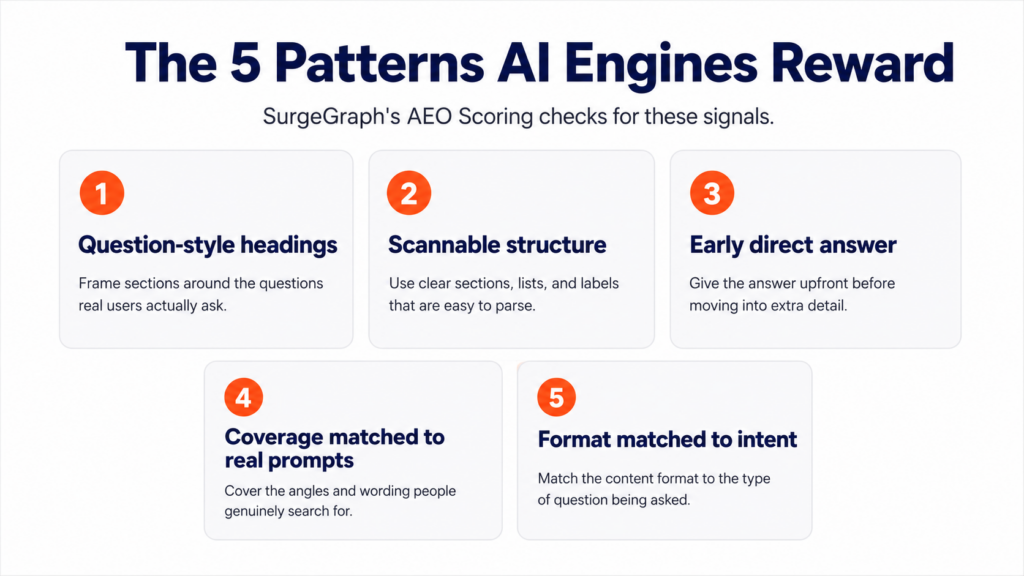
That usually comes down to five structural patterns.
a) Question-style headings. AI prompts are often phrased as questions. Headings that mirror real user questions make it easier for engines to match your content to the query.
b) Scannable structure. Lists, tables, numbered steps, and short sections are easier for AI systems to parse than dense paragraphs.
c) An early, direct answer. A concise answer block (under roughly 150 words) near the top gives the engine something easy to extract. Bury the answer five sections deep and you lose the queries that want a fast response.
d) Coverage that matches real prompts. AI engines look for the entities and sub-topics that show up in actual user questions on the topic. Coverage gaps are why two well-written articles can earn very different citation rates on the same keyword.
e) Format matched to intent. Comparison questions benefit from tables. How-to questions benefit from steps. Definition questions benefit from short, direct explanations.
The five patterns AI engines reward, at a glance:
Where Most AEO Tools Stop Short
Most AEO tools can tell you where your brand appears in AI answers.
That is useful, but it is only half the job.
A tracking-only platforms may show that your competitor is cited more often than you. It may show that your brand is missing from a key prompt. It may even show sentiment, share of voice, and citation gaps.
Then it stops. The actual fix is up to you and whatever writing tool you happen to use.
Content tools (generic AI writers, optimization plugins) have the opposite problem. They can write or rewrite content, but they do not know which AI prompts your brand is losing. They do not know which competitor is getting cited instead. They do not know whether a page actually improved your AI visibility after publishing.
So teams end up with two disconnected halves:
Analytics that diagnose the problem. Content tools that do not understand the diagnosis.
Want to try SurgeGraph for free?
Generate 20 documents
SEO tools (Auto Optimizer, Internal Linking, and more)
AEO needs a workflow where tracking, scoring, fixing, and reporting happen in one connected system.
That is the gap the new SurgeGraph was built to close.
Introducing the New SurgeGraph
We’ve been building AI-powered content and search tools for years. So when AI answer engines started replacing the search results our customers compete in, building for AEO wasn’t a pivot — it was the next obvious move.
The new SurgeGraph is an AI visibility and AEO platform built to help brands get cited in AI answers, then prove what those citations produce.
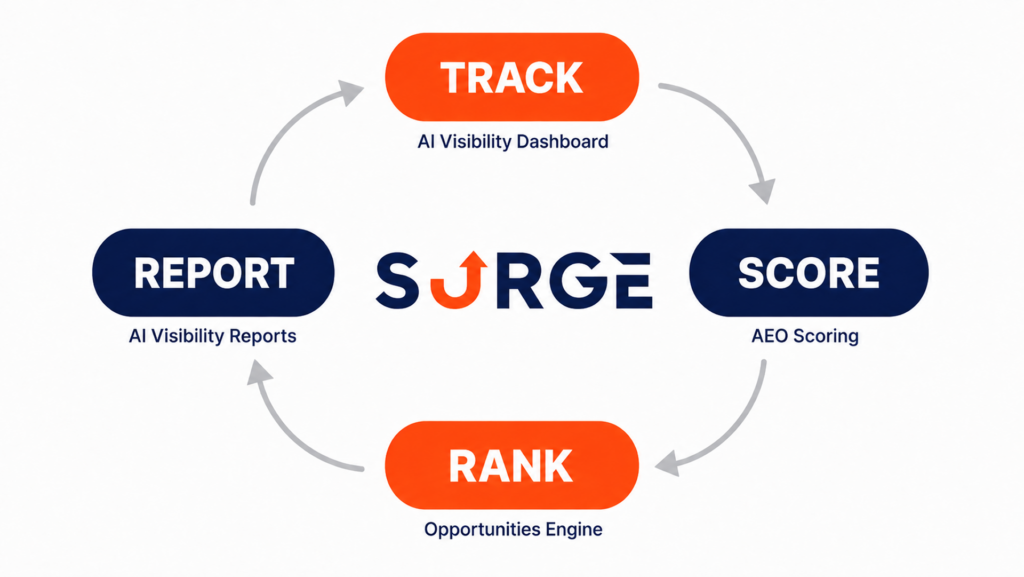
It does that by closing the loop the tracking-only tools leave open in four steps:
Track. SurgeGraph watches how your brand shows up across ChatGPT, Perplexity, Gemini, Google AI Mode, and Google AI Overview.
Score. It rates how likely each of your pages is to be cited by those engines.
Rank. The Opportunities engine sorts your visibility gaps by frequency, severity, and relevance, so you work the highest-impact ones first.
Report. Every visit your pages earn gets traced back to the exact AI engine that sent it, then packaged into a report that proves the lift.
That’s the loop. Traffic from AI answers stops being invisible.
This is the biggest difference.
SurgeGraph does not only show that a page is missing from AI answers.
It helps you understand why, fix the structure, monitor what changes, and turn the outcome into a report.
How SurgeGraph Closes the AEO Loop
Track AI Visibility Across Five Answer Engines
The AI Visibility Dashboard shows how your brand appears across ChatGPT, Perplexity, Gemini, Google AI Mode, and Google AI Overview.
You can track mentions, citations, sentiment, share of voice, and prompt-level performance in one workplace. and share of voice, all in one workspace.
What makes those numbers trustworthy is the proprietary brand extraction layer. Real AI answers rarely use your exact brand name — they say “Surge,” “Surge Graph,” or just “their tool.” Exact-match trackers miss every one of those and quietly undercount you.
SurgeGraph catches the abbreviations, misspellings, and informal mentions too, so the citation share you report is one you can defend in a client meeting.
Prioritize What to Fix First
Knowing you have visibility gaps is helpful, but knowing which gap to fix first is better.
The Opportunities engine turns AI visibility data into a prioritized action list. Instead of handing you a long table of disconnected gaps, it sorts opportunities by priority: high, medium, and low across three categories: visibility gaps, expansion opportunities, and competitor intel.
This turns AI visibility analysis into a working content queue.
For agencies, that is especially useful. Instead of telling a client, “Your visibility is low,” you can say, “Here are the highest-priority actions we are taking next, and here is why they matter.”
Score Pages for AEO Readiness
Once you know which page needs work, SurgeGraph shows why it may not be getting cited.
AEO Scoring checks whether the page follows the structural patterns AI engines tend to reward, such as:
Missing question-style headings.
Dense sections that should be turned into lists or tables.
No direct answer near the top.
Coverage gaps around related entities or prompt topics.
A format that does not match the user’s search intent.
Instead of leaving the team to guess, SurgeGraph flags the specific section that needs attention, making optimization more practical.
Apply One-Click Structural Fixes
After SurgeGraph identifies the issue, the fix happens in the same workspace. Click Fix, and SurgeGraph rewrites only the affected section.
Every fix shows a before-and-after diff, so you review and approve each change before it’s applied. Nothing rewrites silently.
The goal is not to let AI rewrite the whole page without oversight. The goal is to apply targeted structural improvements that make the content easier for answer engines to parse and cite.
Connect AI Visibility to Real Traffic
Visibility is only part of the story.
Teams also need to know whether AI answers are sending visitors to the site.
The Traffic Impact Dashboard connects AI visibility work to actual website traffic through the SurgeGraph WordPress plugin. It streams referral logs to the platform and attributes visits to AI sources across eight LLM platforms: OpenAI, Google, Anthropic, Microsoft, Perplexity, Apple, Meta, and Grok.
This helps teams answer a question most analytics tools do not answer clearly:
Which AI platforms are actually sending traffic to our pages?
The dashboard breaks this down by platform and landing page, with visual flows that show where AI-driven visits are coming from and where they land.
Turn the Work Into Client-Ready Reports
For agencies and teams reporting to stakeholders, the final step is proof.
SurgeGraph generates AI Visibility Reports as shareable, multi-page reports. They can be white-labeled, password-protected, and shared through secure links.
Each report shows visibility performance, citation gains, sentiment, topic movement, and traffic impact for the selected date range.
Want to try SurgeGraph for free?
Generate 20 documents
SEO tools (Auto Optimizer, Internal Linking, and more)
Clients do not need access to the platform, and they can already get a clear report showing what changed and why it matters.
Then the loop starts again.
The data from tracking and reporting flows back into the Opportunities engine, which helps the team decide what to work on next.
Track → Score → Rank → Report → Repeat.
What Real Users Are Seeing
Early users are already seeing what happens when AEO becomes a connected workflow instead of a manual process.
“I canceled all SEO tools because of the whole AI taking over Google. Nothing was working to recover traffic. But I’m resubscribed to Surge now, and I am already seeing great early results in just 2 days!” Lin, SurgeGraph User
“By following your advice and taking advantage of the opportunities offered by Surge, I was mentioned 10 times in AI systems within 24 hours. I paired Surge with Claude AI using different skills, and it’s a game changer.” Cyril Garitey, SEO/AI Consultant in France
Lin recovered traffic that the AI search shift had taken away. Cyril went from missing in AI answers to being cited ten times across answer engines in a single day.
Both moved on the same loop. Find the gap, fix the page, watch the citation pattern change.
That is what makes the new SurgeGraph different from a dashboard that only shows what went wrong.
Why This Matters for Agencies and Content Teams
AI search has changed the client conversation.
It is no longer enough to say, “This page ranks.”
Clients also want to know:
Does ChatGPT mention us? Does Perplexity cite us? Does Gemini understand our positioning? Does Google AI Overview use our content as a source? Are competitors showing up where we are missing?
And most importantly, what are we doing about it?
SurgeGraph gives teams a way to answer those questions without building a manual tracking process from scratch.
Agencies can use it to monitor clients, prioritize content actions, and produce white-label reports.
Content teams can use it to decide which pages to improve, which gaps to fill, and which formats AI engines appear to reward.
Brand operators can use it to understand whether their market positioning is showing up in the answers their customers now read.
Final Thoughts
AI search is not a future trend waiting to arrive.
It is already changing how people find brands, compare products, and choose who to trust.
The challenge is that AI visibility is harder to track than traditional rankings. It moves across engines, prompts, citations, sentiment, and traffic sources.
The new SurgeGraph was built for that reality.
It tracks how your brand appears across major AI answer engines.
It scores your pages for citation readiness.
It prioritizes the opportunities that matter most.
It applies targeted structural fixes.
And it turns the results into reports your team or clients can actually use.
If SEO helped brands compete for rankings, AEO helps them compete for answers.
What’s the difference between an AEO tool and a traditional SEO tool?
A traditional SEO tool helps content perform in search engines like Google and Bing. It usually focuses on keyword research, ranking data, backlinks, on-page optimization, and technical SEO.
An AEO tool focuses on whether AI answer engines cite, mention, or recommend your brand in generated answers.
The two work together. SEO helps your content get indexed and discovered. AEO helps your content become easier for AI engines to extract, summarize, and cite.
Can SurgeGraph track AI visibility for content in languages other than English?
A: Yes. Each SurgeGraph project supports a configured location and language.
This helps teams track AI visibility, monitor prompts, and generate content for specific markets. Brands running multilingual content programs can set up separate projects for different regions or languages to keep the data clean.
Does SurgeGraph work for ecommerce sites, or only blog content?
SurgeGraph can be used for ecommerce sites as well as blog content.
The AI Visibility Dashboard tracks brand mentions and citations regardless of content type. Ecommerce teams can monitor whether AI engines cite product pages, category pages, buying guides, comparison content, or FAQ sections.
AEO Scoring and structural fixes can also be applied to imported HTML content, including product descriptions and category copy.
Can I use SurgeGraph alongside my existing SEO tool?
Yes, and most users do. SurgeGraph is designed to layer on top of an existing SEO stack rather than replace it.
SEO tools handle keyword research, rank tracking, and backlink analysis for traditional search; SurgeGraph handles AI visibility tracking, AEO scoring, and one-click structural fixes for AI search. Many teams continue using their existing SEO stack and run SurgeGraph for the AEO layer in parallel.
How often does the AI visibility data refresh in the dashboard?
The AI Visibility Dashboard refreshes tracking data on a scheduled cadence, depending on the project settings and plan.
Teams can configure tracking schedules and monitor when the last analysis was completed. Traffic Impact data works separately through the WordPress plugin, which streams referral logs and attributes AI-sourced visits closer to real time.
NOTE:
This article was written by SurgeGraph's AI writer using a custom Author Synthesis voice profile, then reviewed by a human editor. Author Synthesis learns a brand's voice from real writing samples so generated content matches its tone, cadence, and phrasing. Right: Never miss out on expert AI visibility tips & strategies
Eli Taylor
Digital Marketer at SurgeGraph
Eli lives and breathes digital marketing and AI. He always seeks new ways to combine AI with marketing strategies for more effective and efficient campaign executions. When he’s not tinkering with AI tools, Eli spends his free time playing games on his computer.