ChatGPT, Gemini and Google's AI Overviews had the same most-named tool on only 1 of 4 agency questions we tracked. So the list of AEO tools for agencies you get depends on which AI you ask.
A common belief in agency AEO (answer engine optimization, getting your brand into AI answers) is that the AIs agree on which tools suit agencies, so any tracker will do. We tested it.
We took 4 agency questions (prompts) from the 23 we track and read the three AIs' answers on 37 run dates, from July 9 to October 18, 2026. That gave 392 answers: 132 from ChatGPT, 132 from Gemini and 128 from Google AI Overviews.
Data window: 2026-07-09 to 2026-10-18.
The short version:
On "Which AEO tool is best for agencies", ChatGPT and Google AI Overviews named Profound most often, and Gemini named Rankability.
All three AIs had the same most-named tool on 1 of 4 agency questions: Semrush, on combined AEO and SEO reporting.
ChatGPT named 123 different brands on the 4 agency questions, Gemini 130 and Google AI Overviews 77.
Tools an AI named in at least half its answers still came and went 25.7% to 33.0% of the time between checks.
The Three AIs Disagreed on the Most-Named Tool for 3 of 4 Questions
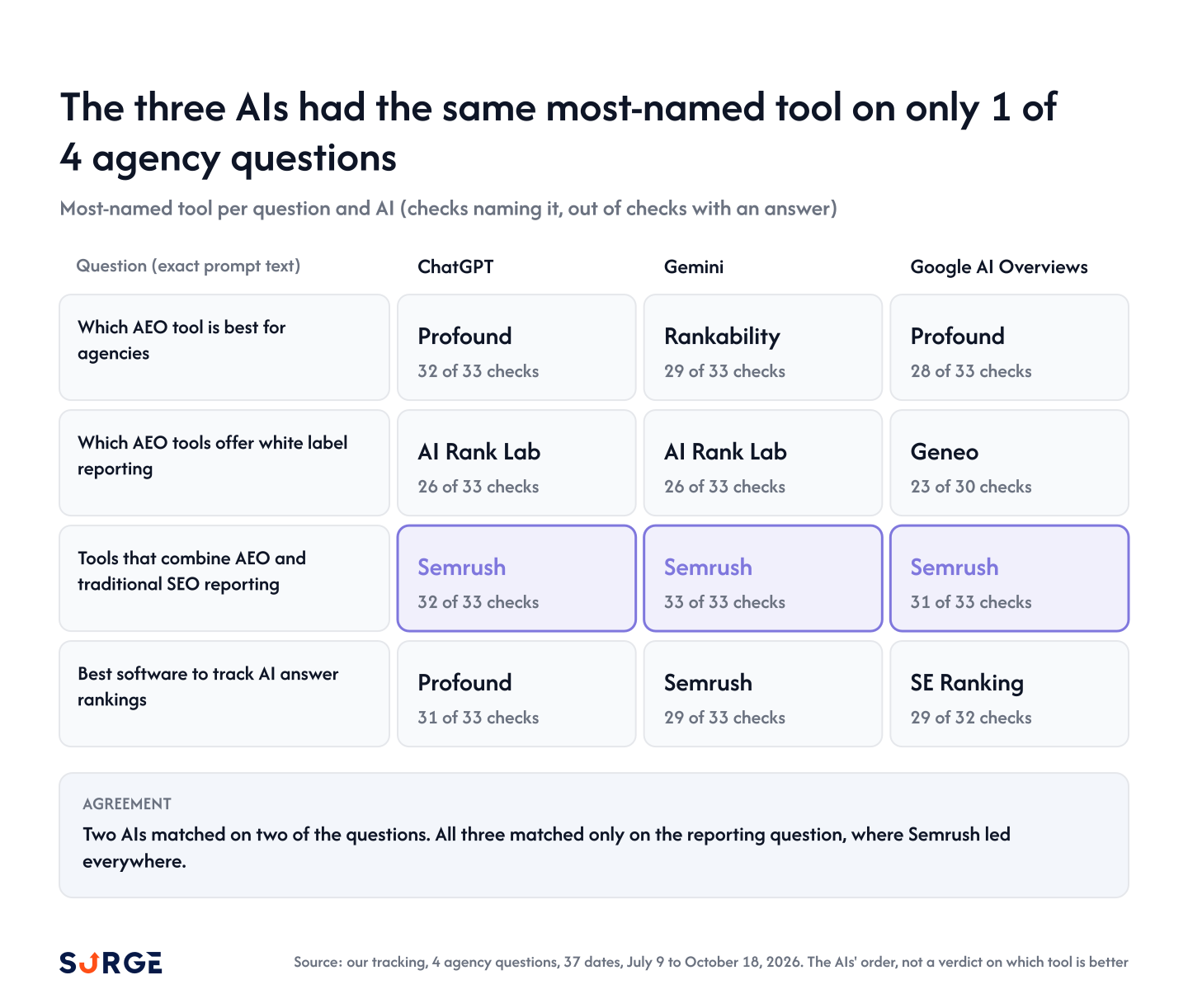
Table 1 shows each AI's most-named tool per question, with the checks naming it out of the checks where that AI gave an answer:
Question (exact prompt text)
ChatGPT
Gemini
Google AI Overviews
Which AEO tool is best for agencies
Profound 32/33
Rankability 29/33
Profound 28/33
Which AEO tools offer white label reporting
AI Rank Lab 26/33
AI Rank Lab 26/33
Geneo 23/30
Tools that combine AEO and traditional SEO reporting
Semrush 32/33
Semrush 33/33
Semrush 31/33
Best software to track AI answer rankings
Profound 31/33
Semrush 29/33
SE Ranking 29/32
Two AIs matched on two of the questions. All three matched only on the reporting question, where Semrush led everywhere.
The same grid at a glance:
The AIs' order for each question, not a verdict on which tool is better.
What this means for agencies: on these 4 questions, the category picture depended on which AI you asked. Report each AI on its own line, never one blended figure.
Which Tools Each AI Named Most, Up to 83.3% of Answers
Share here means the share of an AI's answers on the 4 agency questions together that named the tool. The order is the AIs' order, not ours, and "named most often" is all it says.
Table 2 lists the 5 tools each AI named most (answers naming the tool in brackets):
Order
ChatGPT (132 answers)
Gemini (132 answers)
Google AI Overviews (128 answers)
1
Profound 83.3% (110)
Semrush 67.4% (89)
Semrush 62.5% (80)
2
Semrush 69.7% (92)
SE Ranking 53.0% (70)
Profound 52.3% (67)
3
OtterlyAI 61.4% (81)
Ahrefs 39.4% (52)
SE Ranking 43.8% (56)
4
Peec AI 56.8% (75)
OtterlyAI 39.4% (52)
OtterlyAI 39.8% (51)
5
Ahrefs 47.0% (62)
Profound 37.9% (50)
Frizerly 36.7% (47)
We call a tool a regular when an AI names it in at least half its answers to a question. Twenty tools were regulars for at least one AI on at least one agency question.
Only 5 of them were regulars on all three AIs:
AI Rank Lab
Ahrefs
OtterlyAI
Profound
Semrush
The answers are also crowded. ChatGPT named 7.23 brands per answer, Gemini 7.12 and Google AI Overviews 5.59.
Across the 4 questions, that came to 123, 130 and 77 different brands. These are raw brand totals, and not every brand an AI names is an AEO tool.
How crowded each AI's answers were:
4 agency questions, 392 answers.
What this means for agencies: on these 4 questions, a tool list built from one AI would have missed part of the field.
Even the Regular Picks Came and Went From One Check to the Next
A tool comes and goes when an AI names it on one check and not on its next check with an answer, or the reverse. Table 3 shows how often that happened (changes / gaps between checks):
AI
Regular tools
Every tool it named
ChatGPT
25.7% (156 / 608)
15.0% (798 / 5,312)
Gemini
33.0% (190 / 576)
14.8% (909 / 6,144)
Google AI Overviews
26.7% (123 / 460)
15.7% (580 / 3,689)
Get Your Clients Cited Where Competitors Already Are
Regular picks change more often by this measure. A tool named only once or twice is missing almost every time, so it rarely has anything to change.
The two rates side by side:
How often tools came and went between two checks, by AI.
Some picks held firm. Semrush on the combined reporting question was named in all 33 Gemini answers and stayed named across all 32 gaps between checks.
Profound on "best for agencies" was named in 32 of 33 ChatGPT answers and changed in 2 of 32 gaps.
Others swung: one tool ChatGPT named in about half its answers on the agencies question (16 of 33) changed in 18 of 32 gaps.
The likely reason is that each AI retrieves from its own mix of pages, and on these questions most of the most-cited websites were tool vendors' own sites. Our data shows the pattern, but it cannot test the cause.
What this means for agencies: one check is a snapshot, so judge a tool's place in AI answers over several checks.
Where the Answers Come From: Google AI Cited One Blog in 64 of 124 Answers
Cited websites are the sites an answer links to as sources. We kept raw web addresses, so www. and other subdomains are separate websites:
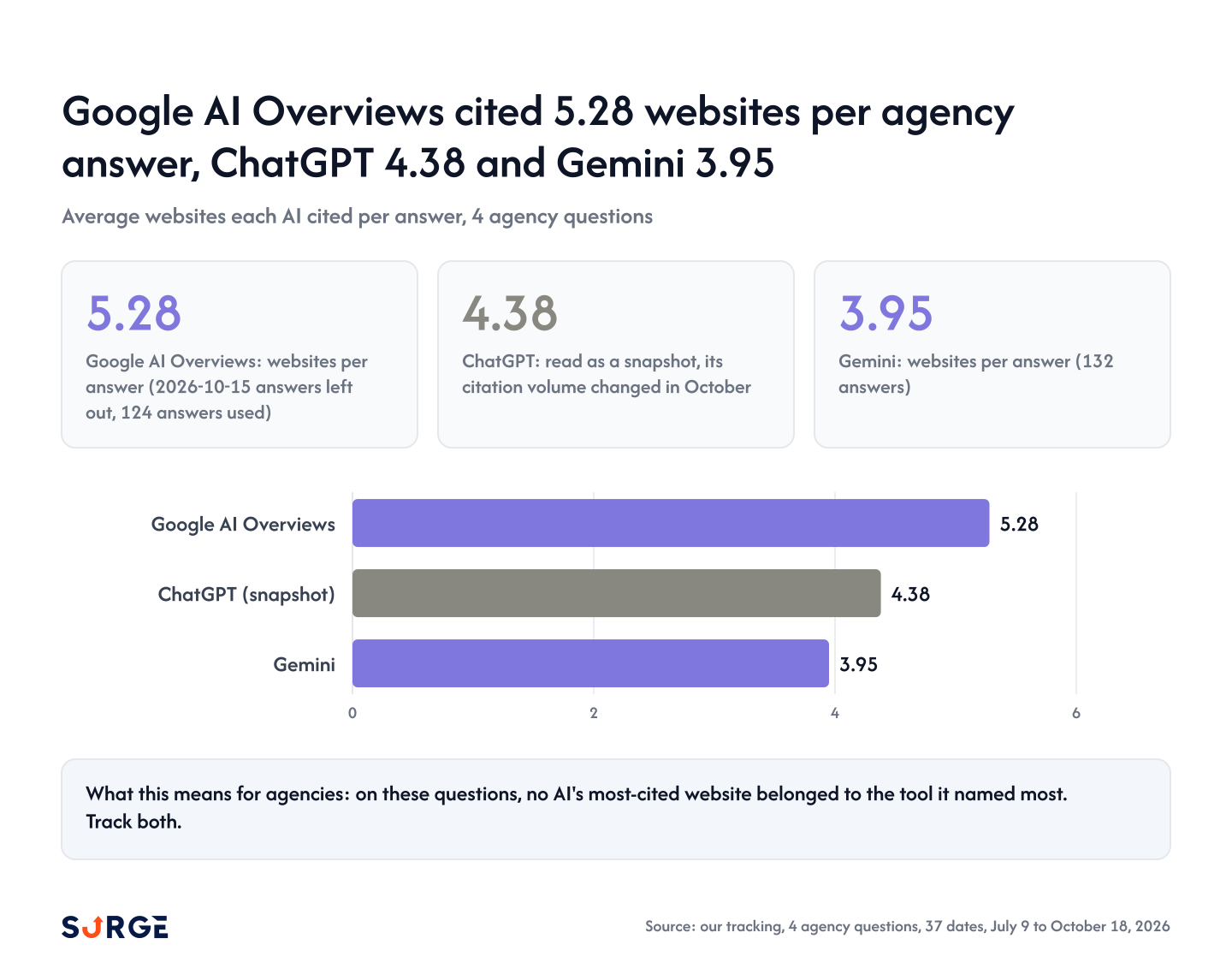
Google AI Overviews answers from 2026-10-15 are left out because our tracking recorded no citations that day. ChatGPT's citation volume changed in October, so read its column as a snapshot.
The gap is wider on a fifth, general question we track, "which AEO tool should I pick". ChatGPT cited no website in 20 of 33 answers, against 4 of 33 for Gemini and 1 of 30 for Google AI Overviews.
The same October caveat applies to ChatGPT. Websites cited per answer, by AI:
4 agency questions; Google AI Overviews' 2026-10-15 answers left out.
What this means for agencies: on these questions, no AI's most-cited website belonged to the tool it named most. Track both.
How to Choose an AEO Tool for Your Agency: 5 Questions to Ask
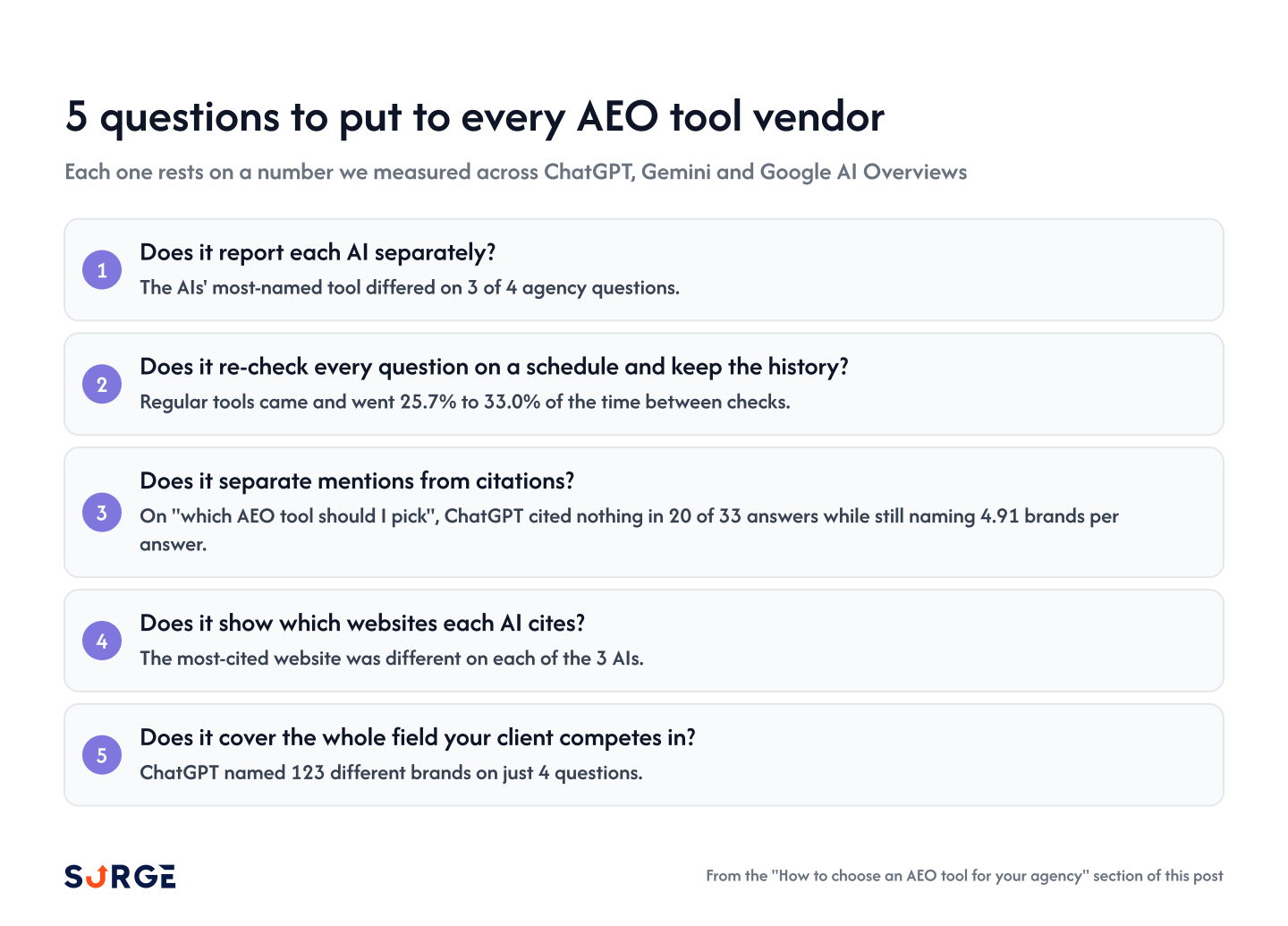
Put these to every vendor. Each rests on a number above.
1. Does it report each AI separately? The AIs' most-named tool differed on 3 of 4 agency questions.
2. Does it re-check every question on a schedule and keep the history? Regular tools came and went 25.7% to 33.0% of the time between checks.
3. Does it separate mentions from citations? On "which AEO tool should I pick", ChatGPT cited nothing in 20 of 33 answers while still naming 4.91 brands per answer.
4. Does it show which websites each AI cites? The most-cited website was different on each of the 3 AIs.
5. Does it cover the whole field your client competes in? ChatGPT named 123 different brands on just 4 questions.
The five questions on one card:
Each question and the number behind it.
What to Do This Week With Your Agency's AEO Tools
Four moves, each tied to a number above:
Get Your Clients Cited Where Competitors Already Are
1. Ask the 3 AIs your client's top category question and log each answer separately. They agreed on the most-named tool for only 1 of our 4.
2. Judge a tool's place in AI answers over several checks, not one. Regular picks still dropped out or came back 25.7% to 33.0% of the time.
3. Check the pages the AIs cite, apart from the names they give. Google AI Overviews cited one blog in 64 of 124 agency answers.
4. Put the 5 questions above to every vendor demo. Each one maps to a gap we measured, such as the 123 brands ChatGPT named on 4 questions.
The four moves on one card:
The four moves and the numbers behind them.
When this doesn't apply: if your clients sit outside the AEO-tool category, reuse the method and measure again rather than carrying our numbers over. Our questions were all AEO-tool questions in US English.
What This AEO Tools Data Can't Tell You
What our tracking covered, at a glance:
The scope behind every number in this post.
Sample: 5 of the 23 questions we track (4 agency questions plus "which AEO tool should I pick"), 3 AIs, 37 dates, about 33 answers per question per AI.
Scope: one tracked set of questions in US English, in the AEO-tool category only.
Spellings: we treated different spellings of a brand as one brand, using a hand-reviewed list.
Brand lists: these are what the tracker detected, and they include brands that are not AEO tools.
Gaps: on some dates, Google AI Overviews gave no answer to a question. We skipped those checks rather than treating the tool as not named.
Citations: Google AI Overviews citations on 2026-10-15 are a tracking gap and are left out of every citation number. ChatGPT citation volume changed in October.
Disclosure: SurgeGraph publishes this post and ran the tracking in its AI Visibility product. Our own brand sits in this category too, so we kept it out of every table and figure.
Freshness: data last checked on 2026-10-18. AI answers change, so we plan to check again.
Our data shows what the AIs named, not which tool is better.
Conclusion
Pick one client, take its top 4 questions and put the 5 vendor questions to your current tool, one AI at a time.
Does being named in an AI answer mean the AI recommended the tool?
No. A mention means the brand was named; we did not score whether it was recommended or ranked, its sentiment or its position.
Why 37 dates but only about 33 answers per question?
Our checks were mostly 3 days apart, with no same-day repeats. Some scheduled checks were split across two calendar dates, so 37 dates hold about 33 checks per question for each AI.
Do AI answers to agency questions change more than other AI answers?
Not by much. Across all 23 questions we track, a brand an AI had named before came and went 15.7% of the time, against 14.8% to 15.7% on the agency questions.
What do the AIs name when you ask "which AEO tool should I pick"?
Profound and Semrush were the only tools all three AIs named in at least half their answers. Gemini named 8.55 brands per answer, against 6.06 for Google AI Overviews and 4.91 for ChatGPT.
Do these findings hold for Perplexity or Google AI Mode?
We can't say from this data, because our tracking covered ChatGPT, Gemini and Google AI Overviews only.
NOTE:
This article was written by SurgeGraph's AI writer using a custom Author Synthesis voice profile, then reviewed by a human editor. Author Synthesis learns a brand's voice from real writing samples so generated content matches its tone, cadence, and phrasing.
Eli Taylor
Digital Marketer at SurgeGraph
Eli lives and breathes digital marketing and AI. He always seeks new ways to combine AI with marketing strategies for more effective and efficient campaign executions. When he’s not tinkering with AI tools, Eli spends his free time playing games on his computer.