LLM SEO is the practice of making your content easy for large language models like ChatGPT, Gemini, Perplexity and Google's AI Overviews to find and cite when they answer a question. Done well, those answers mention your brand and link your pages as sources.
Ask ChatGPT for the best email marketing tool for a small nonprofit, and you get a short list of brands instead of ten blue links. LLM SEO is the work of getting onto that list.
Most of it builds on the SEO you already do, with a new goal and a new way to check results.
What Is LLM SEO?
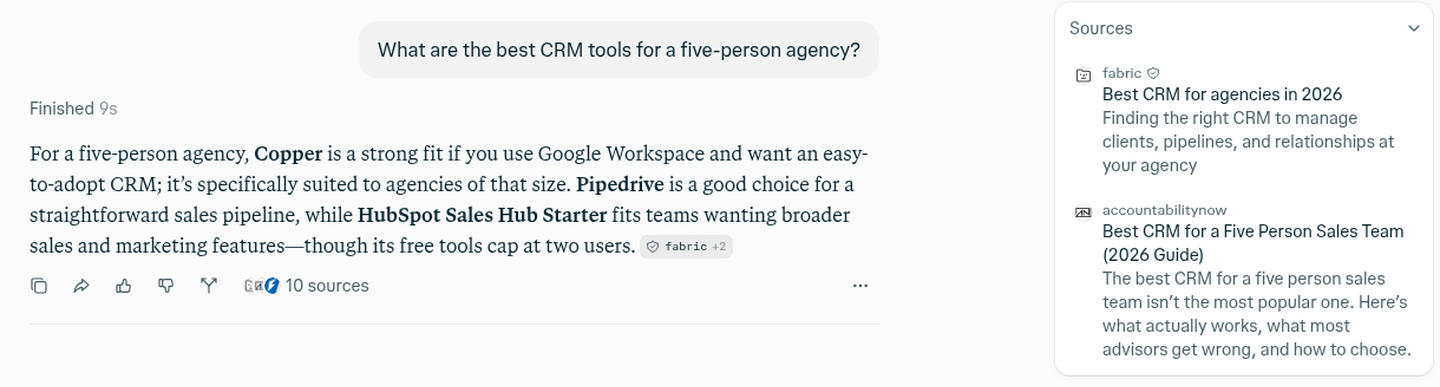
Open Perplexity and ask which CRM suits a five-person agency. The answer mentions a few brands in its text and lists the pages it pulled from as sources.
That one answer shows the two wins LLM SEO goes after:
A mention: the answer text mentions your brand.
A citation: the answer links one of your pages as a source.
You can get one without the other. An answer can mention you without linking you, or cite your page while it recommends a competitor.
A Perplexity answer to a software question, with brands mentioned in the text and the cited pages listed beside it:
Image credits to Perplexity
LLM stands for large language model, the kind of AI behind ChatGPT, Gemini and Claude.
You'll also see LLM SEO called LLM optimization (LLMO), SEO for LLMs or AI SEO. They all describe the same job.
Why Is LLM SEO Important?
More of your buyers now get an answer before they see a link. In a Pew Research Center study of 900 U.S. adults' browsing in March 2025, 58% ran at least one Google search that showed an AI summary.
Those searches sent fewer clicks. People clicked a regular result in 8% of visits with an AI summary, against 15% without one, and clicked a link inside the summary in 1% of visits.
If your brand is in the answer, you still reach the buyer who never clicks. If it isn't, a competitor gets that spot.
LLM SEO vs SEO vs GEO vs AEO
You can see the difference on one Google results page. The AI Overview at the top answers the question in a paragraph, and the ranked links appear below it.
Classic SEO aims for a spot in those links. LLM SEO aims for a place inside the answer itself.
In practice, the three terms overlap so much that most teams use them interchangeably and apply the same tactics.
How LLMs Find and Use Your Content
OpenAI runs two separate crawlers. OAI-SearchBot finds pages for ChatGPT's search answers, while GPTBot collects content that may be used to train its models (OpenAI).
So an AI model can draw on your content in two ways.
a) Training data
This is what the model learned before anyone asked a question. It shapes what the model already "knows" about your brand, but it updates slowly and you can't edit it directly.
b) Live search
This is what the AI fetches from the web at the moment someone asks. Pages it finds this way can be quoted and cited in the answer, which makes live search the part you can work on today.
Each major engine documents its own rules for live search:
Get Your Clients Cited Where Competitors Already Are
ChatGPT: your pages need to be open to OAI-SearchBot to appear in its summaries and snippets.
Perplexity: PerplexityBot finds and links sites for Perplexity's answers and is not used to train AI models (Perplexity).
Google: a page must be indexed and eligible to show a snippet before it can appear as a supporting link in AI Overviews or AI Mode (Google Search Central).
If you want a tour of the engines themselves, we compare them in our roundup of AI search engines.
How to Do LLM SEO in 6 Steps
Work through them in order, since step 1 gives you the question list the later steps use.
#1 Write down the questions your buyers ask AI
Write them the way a buyer would type them into ChatGPT. If you run an accounting firm, your list might include "best accountant for freelancers" or "do I need an accountant for an LLC?"
Aim for 10 to 20 questions, including comparisons and "best X for Y" prompts. Keep the wording fixed, because a reworded question is a new question.
Run each one in the engines your buyers use, and note which brands get mentioned and which pages get cited.
That list is your baseline for step 6.
#2 Let the AI search crawlers in
Open your robots.txt and check your CDN or firewall bot rules. A blanket rule that blocks "all AI bots" also blocks OAI-SearchBot and PerplexityBot, which keeps you out of their answers.
Google asks you to confirm crawling is allowed in both robots.txt and your CDN or hosting settings. Decide on each bot by name, and block only the training crawlers if that's your policy.
#3 Answer the question in the first sentence
Use question-style headings and put a direct answer under each one. Under "Do I need an llms.txt file?", the first words should be "No, not for Google," followed by the detail.
AI answers often quote a single passage.
Write each section so it makes sense on its own. Then an AI can quote it as is.
The same study found that keyword stuffing, the old SEO habit, did worse than leaving the page alone.
Add an author byline and a last-updated date too. If you use structured data, keep it in line with the text people can see, as Google asks.
#5 Get mentioned on the sites AI answers cite
Look back at the sources from step 1. For many questions, the cited pages belong to review sites, forums and roundup posts that write about the brands in the answer.
Those are the sites to work on. Ask happy customers for reviews, keep your listings accurate, and offer expert quotes to the publications that keep showing up.
#6 Keep pages fresh and recheck on a schedule
Update prices and dates when they change, and show when the page was last updated.
Then rerun your question list every two weeks. AI answers change from day to day, so judge the trend over a month or two.
Share of voice: how often answers to your questions mention your brand, compared with competitors.
Citations: how often your own pages appear in the answers' sources.
AI referral traffic: visits from chatgpt.com, perplexity.ai and other AI engines in your analytics.
For the first two, a simple spreadsheet works. Give each question a row, then add columns for the date, the engine, whether your brand was mentioned, whether your page was cited, and which domains were cited.
Read the trend every few weeks. Are you mentioned more often than last month, and is the citation going to your own page or to a third-party page that talks about you?
Common LLM SEO Mistakes
Most LLM SEO problems come from a handful of habits:
1.Blocking search crawlers along with training crawlers. OpenAI and Perplexity run separate bots for each, so one blanket block can keep you out of their answers.
2.Padding pages with keyword variations. In the Princeton study, keyword stuffing did worse than leaving the page alone.
3.Marking up content the page doesn't show. Google asks that structured data match the visible text.
4.Only working on your own site. Third-party pages often get the citation, so they need your attention too.
5.Treating llms.txt as a must-have. It's a proposed standard, and Google says you don't need any new AI text files to appear in AI Overviews or AI Mode.
Conclusion
LLM SEO comes down to five habits: know the questions your buyers ask, let the AI search crawlers in, answer in plain words backed by sources, get mentioned on the sites AI answers cite, and track your mentions and citations over time.
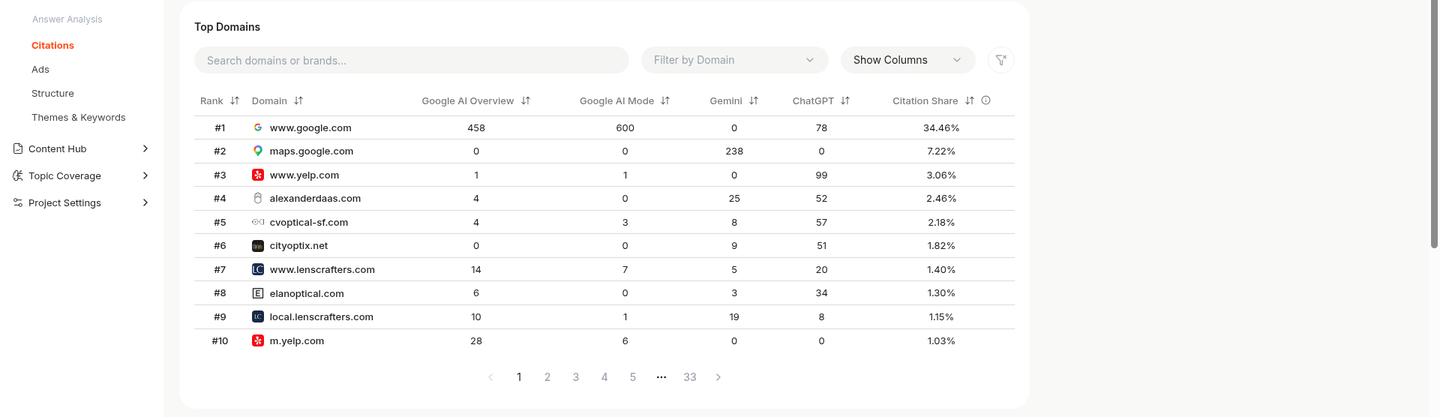
If you'd rather not run the spreadsheet by hand, SurgeGraph's AI Visibility dashboard tracks brand mentions and citations across ChatGPT, Perplexity, Gemini, Google AI Mode and Google AI Overview over time. Every plan covers ChatGPT and Google AI Overview, and higher plans add the other engines.
The Citations view in a sample project, showing the domains each AI engine cites most:
If you mean an AI to help with SEO work like research or drafting, test two or three models on the same brief and keep the one that does the job best.
If you mean which AI to show up in, start with the ones your buyers use. Many teams begin with ChatGPT and Google's AI Overviews, then add others, since every engine answers differently.
Is SEO dead now with AI?
No. Google says its usual SEO best practices still apply to AI Overviews and AI Mode, and pages still need to be indexed to appear there.
You now check the AI answer as well as your rank.
Do I need an llms.txt file for LLM SEO?
No, not for Google. Google says you don't need new machine-readable files to appear in its AI features.
Other engines haven't said their answers rely on llms.txt either, so treat it as optional.
How long does LLM SEO take to show results?
There's no fixed timeline. Live search can pick up a new or updated page as soon as it's crawled, while training data changes only when a model is retrained.
Track your question list every two weeks and compare month to month.
NOTE:
This article was written by SurgeGraph's AI writer using a custom Author Synthesis voice profile, then reviewed by a human editor. Author Synthesis learns a brand's voice from real writing samples so generated content matches its tone, cadence, and phrasing.
Eli Taylor
Digital Marketer at SurgeGraph
Eli lives and breathes digital marketing and AI. He always seeks new ways to combine AI with marketing strategies for more effective and efficient campaign executions. When he’s not tinkering with AI tools, Eli spends his free time playing games on his computer.