Type "best CRM for a small agency" into Google and you get ranked links, often with an AI Overview above them. Ask ChatGPT the same question and you get one written answer with a few linked sources.
That split is the whole GEO vs SEO question. SEO (search engine optimization) earns a ranked result and the click, while GEO (generative engine optimization) gets your pages cited or your brand mentioned in AI answers.
(One note before we start: some local SEO guides use "GEO" for geographic targeting. We mean the AI kind here.)
GEO doesn't replace SEO. Google's own guide to AI features says: "There are no additional requirements to appear in AI Overviews or AI Mode, nor other special optimizations necessary."
GEO work differs in three places: the win is a citation, ChatGPT and Perplexity run their own crawlers, and you track questions people ask AI. Below are a sourced side-by-side table, what the two share, where GEO asks for more, how to measure each and one plan for both.
What Is the Difference Between GEO and SEO?
The main difference is which systems pick your page: on Google, AI answers link to pages that already qualify for ranked results. In Google's own example, a search for "how to fix a lawn that's full of weeds" might set off related searches such as "remove weeds without chemicals."
Google calls this query fan-out. Its AI features guide says both AI Overviews and AI Mode may use it to find more supporting pages, so your SEO work feeds them.
Outside Google, ChatGPT search and Perplexity send their own crawlers, and Bing reports Copilot citations in a separate dashboard.
The term comes from a research paper, "GEO: Generative Engine Optimization", by Pranjal Aggarwal and colleagues, accepted to the KDD 2024 conference.
You'll also see AEO (answer engine optimization) and LLM SEO. We treat them as overlapping names for the same goal, and we cover them in our posts on what AEO is and LLM SEO.
One search can end in either kind of result:
The table below lines up those differences, with the source for each row.
GEO vs SEO Side by Side
Take the crawler row first: Google's AI features rely on Googlebot, while ChatGPT search relies on OAI-SearchBot. Each row below comes from the engine's own documentation:
What
SEO
GEO
Source
Where you show up
Ranked results in Google Search
Supporting links in Google AI Overviews and AI Mode, ChatGPT search answers, Perplexity search results, Copilot and Bing AI summaries
Google AI features guide; OpenAI crawler docs; Perplexity crawler docs; Bing AI Performance post
What a win looks like
A link in the classic search results
A supporting link or citation inside the AI answer
Google AI features guide; Bing AI Performance post
Eligibility on Google
Indexed and eligible to show with a snippet
The same, with "no additional technical requirements"
Google AI features guide
Crawlers to allow
Googlebot
Googlebot for Google's AI features, plus OAI-SearchBot for ChatGPT search and PerplexityBot for Perplexity
Google AI features guide; OpenAI crawler docs; Perplexity crawler docs
Special files or markup
The standard Search technical requirements
Nothing extra for Google's AI features: no new machine-readable files, AI text files or special schema.org markup
Google AI features guide; Google AI optimization guide
First-party report
Search Console Performance report, with AI features included in the "Web" search type
Search Console Generative AI performance report; Bing Webmaster Tools AI Performance
Google AI features guide; Search Console Help; Bing AI Performance post
Most rows match. The differences are more engines, a different kind of win and new reports.
The shared rows come first, since most of your effort already goes there.
What GEO and SEO Share
On Google, the entry rule for AI features is the same as for search results. A page "must be indexed and eligible to be shown in Google Search with a snippet," and Google adds: "There are no additional technical requirements."
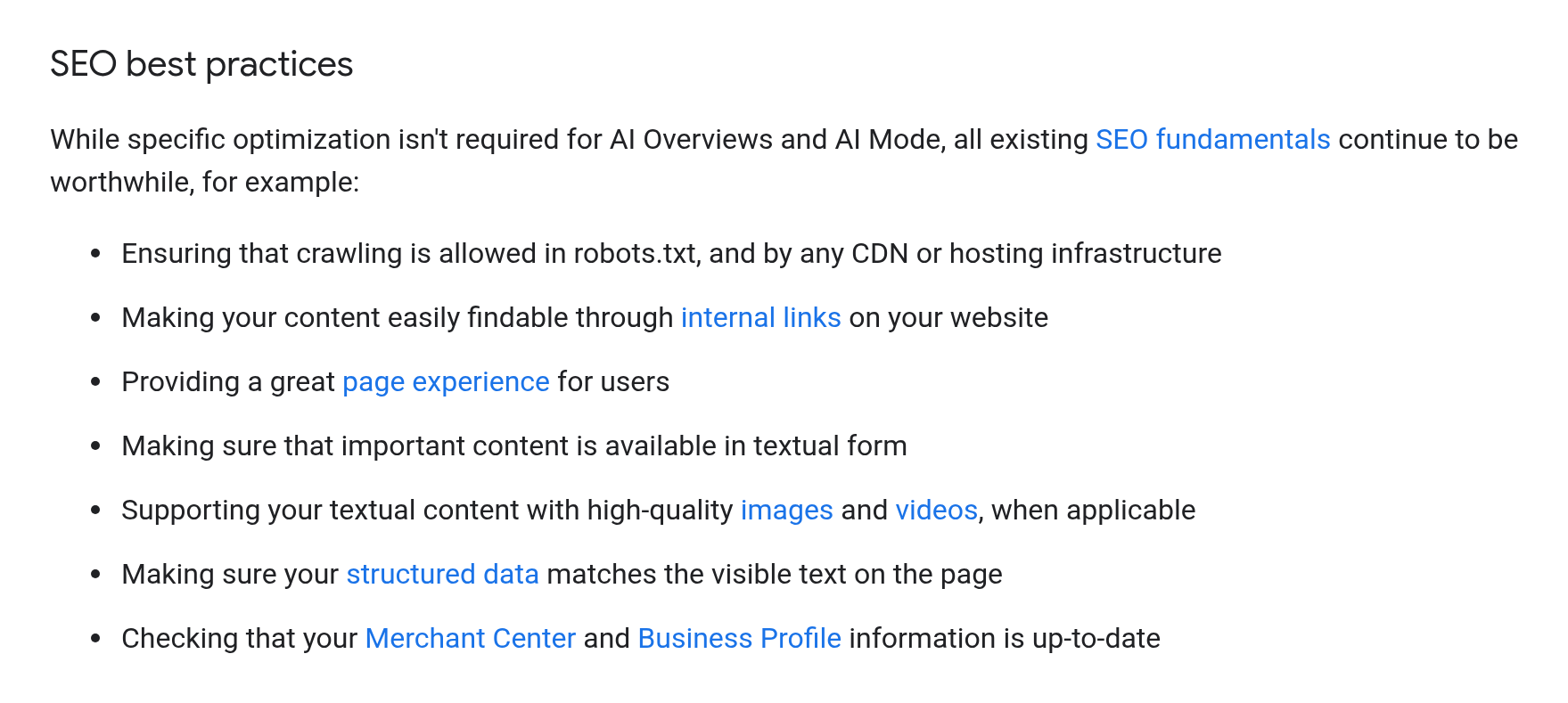
Google's AI features guide then lists the SEO basics that carry over:
The items that apply to almost every site:
Crawl access in robots.txt and in any CDN or hosting setup.
Internal links that make each page easy to find.
A good page experience for the people who land on it.
Important content in text, with images and video to support it where they help.
Content quality is shared too. Google's AI optimization guide contrasts "7 Tips for First-Time Homebuyers," which it calls commodity content, with "Why We Waived the Inspection & Saved Money: A Look Inside the Sewer Line."
The second carries first-hand experience a summary can't copy, and Google asks for that "non-commodity" content in both classic results and AI features.
So the foundation is one job. What GEO adds starts with who crawls your site.
Where GEO Asks for Something Different
Get Your Clients Cited Where Competitors Already Are
GEO adds work in four places, starting with a file you already have: robots.txt decides which AI search engines can read your pages.
a) More engines and more crawlers
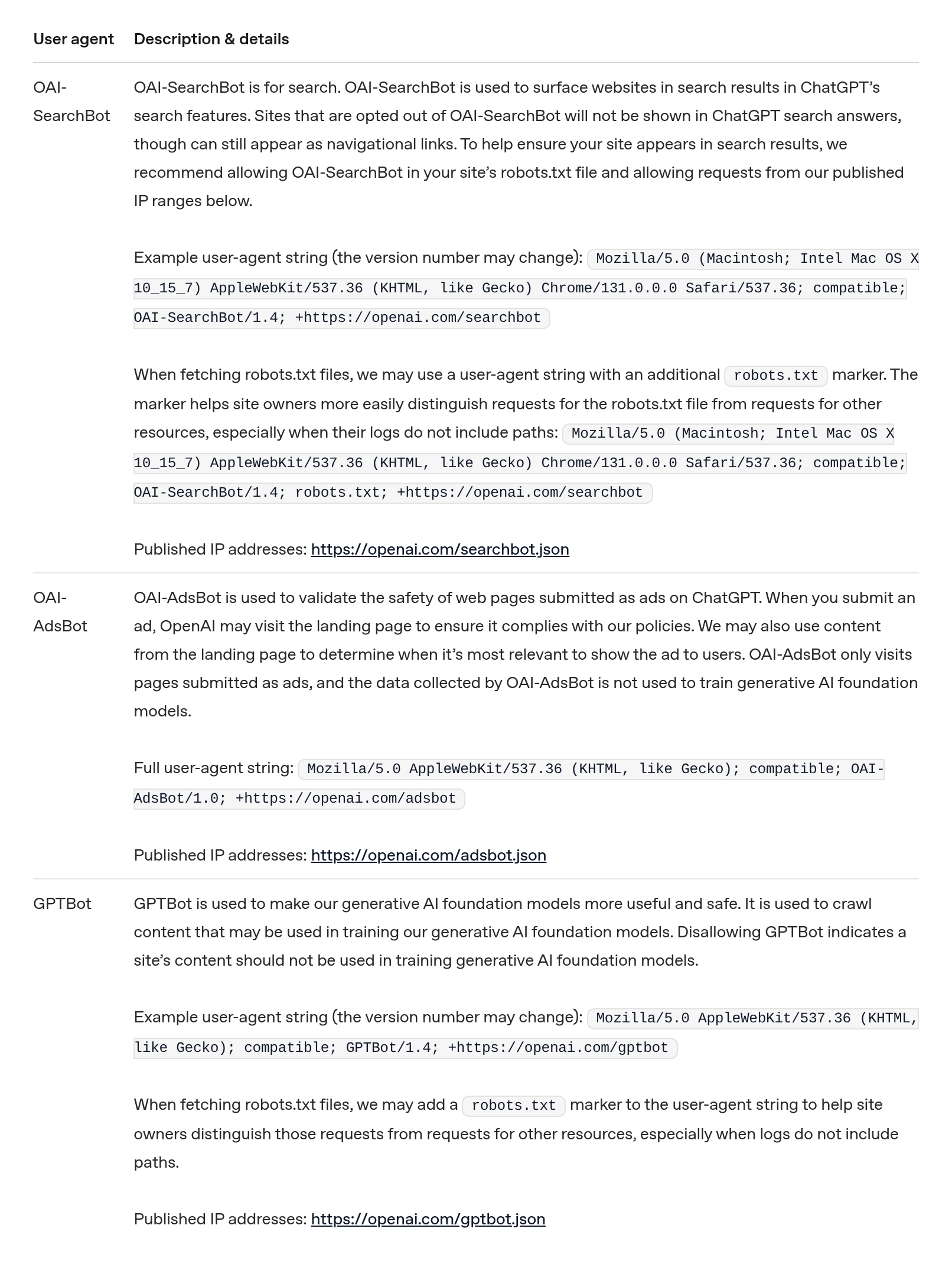
OpenAI's crawler docs say OAI-SearchBot "is used to surface websites in search results in ChatGPT's search features." Sites that opt out "will not be shown in ChatGPT search answers." GPTBot, which OpenAI uses for training, is a separate setting.
Perplexity's crawler docs say PerplexityBot links websites in Perplexity results and "is not used to crawl content for AI foundation models." To let both search crawlers in, add these lines:
Both companies say a robots.txt change can take up to about 24 hours to apply. Here is OpenAI's own table of its crawlers:
b) The win is a citation
In SEO, you check a rank. In GEO, you check whether the answer links to you.
Bing's AI Performance announcement defines Total Citations as citations "displayed as sources in AI-generated answers." Bing calls the report "an early step toward Generative Engine Optimization (GEO) tooling."
c) AI answers don't always show, and they vary
Google says AI Overviews show only when its systems judge them additive to classic Search, so on many searches they don't appear at all.
Google also says AI Mode and AI Overviews "may use different models and techniques, so the set of responses and links they show will vary." One check of one AI feature is a narrow view, so read GEO results across several checks and features.
d) What you can skip on Google
Google's AI optimization guide lists "hacks" you can ignore for Google Search:
AI text files such as llms.txt, which Google Search doesn't use.
"Chunking" content into tiny pieces for AI to read.
Inauthentic "mentions" seeded across the web.
Those four differences shape what you measure, which is where the two disciplines split the most.
How to Measure GEO and SEO
Measure each with its own scorecard. Search Console, for example, now reports AI Overview and AI Mode impressions in a report of their own.
The SEO scorecard stays familiar: the Search Console Performance report (which includes AI features in the "Web" search type), your rank tracking and Google Analytics conversions.
The GEO scorecard has three parts:
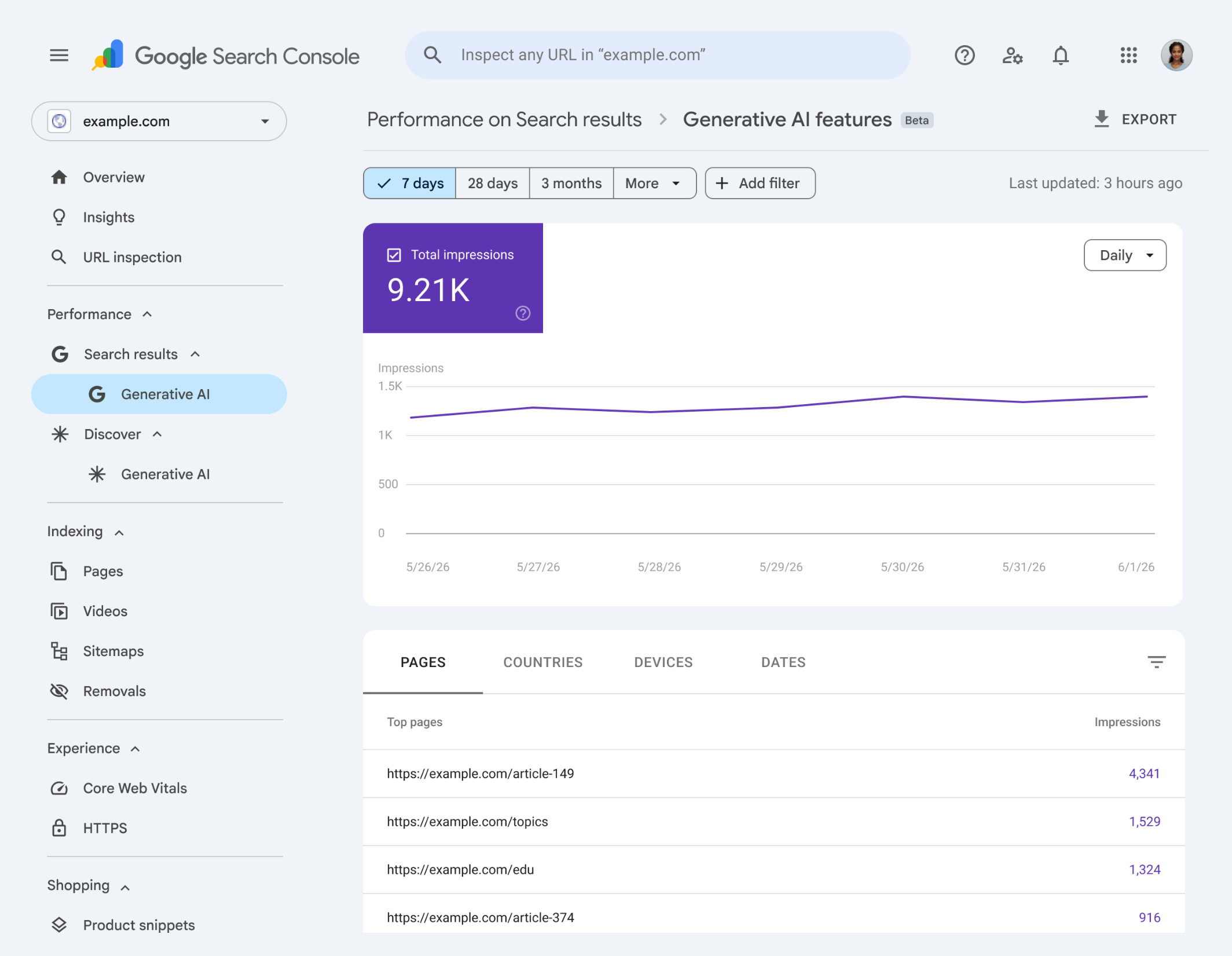
Search Console's Generative AI performance report shows impressions from AI Overviews and AI Mode by page, location, date and device. Google's help page says it rolled out to all websites worldwide as of August 31, 2026.
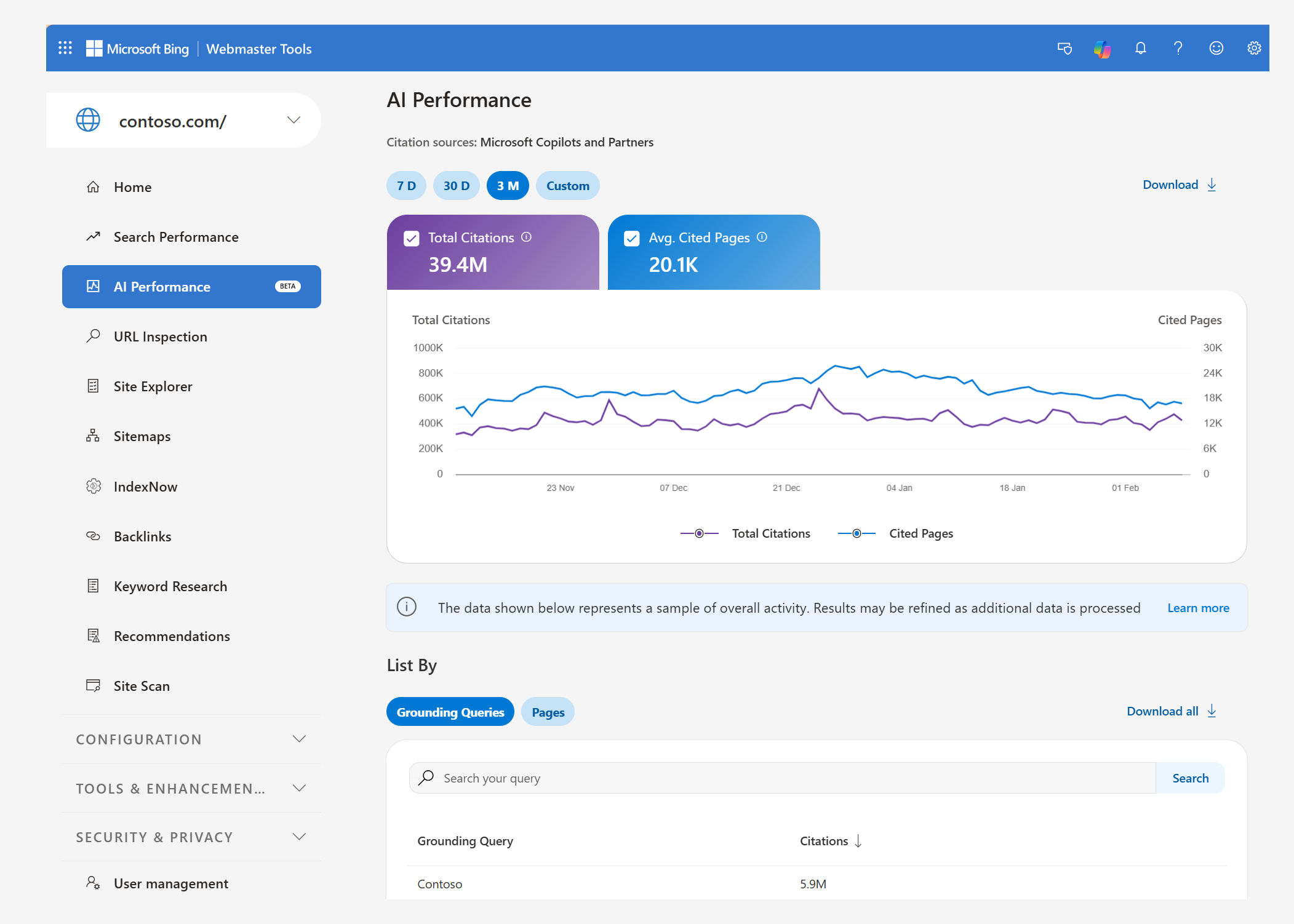
Bing Webmaster Tools AI Performance shows citations across Copilot, AI summaries in Bing and select partner integrations, plus a sample of the grounding queries behind them.
Repeat checks you run yourself cover ChatGPT and Perplexity, whose crawler docs cover access controls only.
The Search Console report can be empty if your site has too few AI impressions, or if it's excluded from Search generative AI features. We cover the Google side in detail in our post on how to track Google AI Overviews.
Here is the report as Google shows it:
Image credits to Google.
And here is Bing's AI Performance dashboard:
Image credits to Microsoft Bing.
For ChatGPT and Perplexity, ask the same questions on a schedule.
Log mentions and citations in separate columns, since an answer can mention your brand without linking your page. Our guide on how to track brand mentions in ChatGPT walks through the full method, and our comparison of AI search visibility tools covers software that runs these checks.
Get Your Clients Cited Where Competitors Already Are
With both scorecards in place, you can run the work itself from one plan.
How to Run SEO and GEO From One Plan
You don't need a second team for GEO. Run each topic, such as "CRM for agencies," through these four steps.
#1 Build one list of keywords and questions
Pair each keyword with the questions buyers ask AI about the same topic. Query fan-out is the reason: Google's AI features run several related searches before writing one answer.
#2 Write one brief, answer first
Answer the question in the first lines of the page, then back it up with sources and first-hand detail. Google's guide warns against separate pages for every search variation, so keep one strong page per topic.
#3 Open the crawlers you want
Allow Googlebot, OAI-SearchBot and PerplexityBot in robots.txt, and check that your CDN doesn't block them. Leave GPTBot as a separate decision, since it controls training.
#4 Check both scorecards on a fixed schedule
Review Search Console and Bing AI Performance on a schedule you can keep. For ChatGPT and Perplexity, repeat each question on several checks before you treat a missing mention as a change.
GEO adds more engines, a citation as the win and new reports to SEO, so run one plan with two scorecards.
SurgeGraph, an AEO and AI visibility platform, covers the GEO side of that plan and the page checks:
Tracking your question list: the AI Visibility dashboard monitors citations and mentions across answer engines over time. Engines are set by plan, up to ChatGPT, Perplexity, Gemini, Google AI Mode and Google AI Overview.
Writing answer-first pages: the AEO scan flags missing question-format headings and absent direct answers, then offers one-click fixes that rewrite those sections.
Checking both scorecards on one page: the document report shows an SEO score and an AEO score, each 0 to 100. The AEO score is a diagnostic of how well the page is structured to be cited.
Seeing the traffic: AI Traffic Impact shows how many visitors arrive from AI channels, which pages they land on and which answer engines send the most.
They describe overlapping work: GEO is generative engine optimization, from the 2023 research paper of that name, and AEO is answer engine optimization. Both aim to get your brand mentioned or your pages cited in AI answers, so most teams use the same tactics for each.
Does GEO change keyword research?
Not much: Google says its AI systems understand synonyms and general meaning, so you don't need every long-tail variation of a query. Keep your keyword research and add the questions buyers ask AI tools about the same topics.
Can you block AI answers and keep your SEO rankings?
Not separately on Google, because it treats AI features as part of Search. The nosnippet, data-nosnippet, max-snippet and noindex controls limit what shows in Search overall, and Google-Extended covers AI training and grounding in some of Google's other systems.
Does GEO matter for local businesses?
Yes. Google's AI optimization guide says AI responses can include local business details, and that a Business Profile or Merchant Center feed helps you show up in AI responses and Search.
Does structured data help GEO?
Google says structured data isn't required for its generative AI search and there's no special schema.org markup to add. It still recommends using structured data as part of your SEO, because it helps pages qualify for rich results in Google Search.
NOTE:
This article was written by SurgeGraph's AI writer using a custom Author Synthesis voice profile, then reviewed by a human editor. Author Synthesis learns a brand's voice from real writing samples so generated content matches its tone, cadence, and phrasing.
Eli Taylor
Digital Marketer at SurgeGraph
Eli lives and breathes digital marketing and AI. He always seeks new ways to combine AI with marketing strategies for more effective and efficient campaign executions. When he’s not tinkering with AI tools, Eli spends his free time playing games on his computer.